
A Master Plan in a Desk Drawer
From certain corners of Lamorran Garden, the UK seems very far away.
Palm fronds sway overhead. White pillars emerge from dense subtropical planting. Stone pathways curve between tree ferns and camellias before disappearing around a bend. Through carefully framed gaps in the foliage, flashes of turquoise ocean appear and vanish again. It is easy to understand why visitors often describe the garden as Mediterranean. That impression is entirely deliberate.
“I’ve always had a southerly progression,” says Robert Dudley-Cooke, owner and creator of Lamorran Garden. “I needed to get to the sea and out to the Mediterranean and when I found it, I couldn’t believe it.”
We are sitting above the sheltered waters of St Mawes, on a south-facing hillside protected on three sides by the sea. The microclimate here is extraordinary. Frost is almost unknown. Plants from South Africa, Australia, New Zealand and South America grow alongside Mediterranean species and old English garden favourites. The result is a place that feels all at once Cornish, Italian and slightly impossible.
Forty-five years ago, however, there was almost no garden here at all. “When I came here there was virtually no garden,” Robert says. “We spent the first fifteen years, my wife and I, creating that garden, and we finally found the bottom of the garden after about fifteen years.”
He pauses briefly. The comment sounds like a joke, but only partly. The original site was a steep, overgrown hillside falling away towards the sea. Creating Lamorran required decades of excavation, planting and persistence. For years Robert commuted from London, travelling down on Friday evenings and spending weekends working on the garden before returning to the city.
Long before the garden existed physically, it existed in his imagination. “I produced a master plan which sat in my desk drawer in my office in Central London,” he says. “I referred to it for recreation on a daily basis at lunchtime.”
There is something wonderfully revealing in this image: a man escaping the demands of the working day by studying plans for a garden that would take decades to complete.
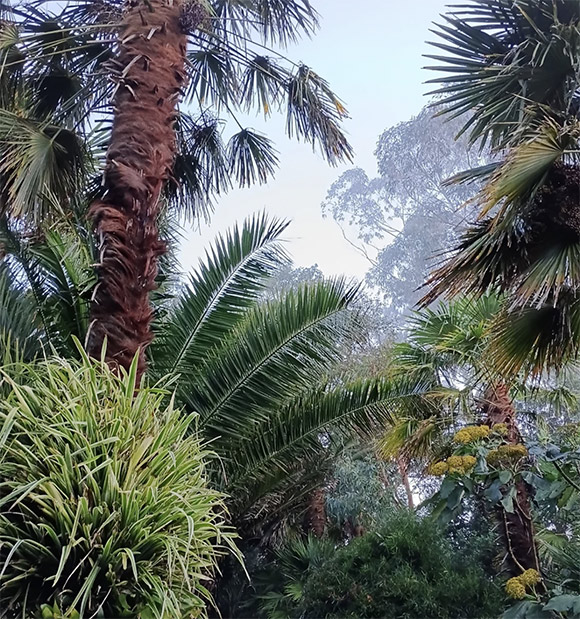
The landscape and planting gives the garden an amazing sense of height .
Japanese Gardens and Italian Sunlight
“The first influence was very much Japanese,” he says. The second arrived through Italy. Robert’s wife, Maria-Antonietta, is Italian, and together they spent years visiting gardens throughout the Mediterranean. Particular inspiration came from the great Italian gardens overlooking the sea.
“I’ve seen a lot of Italian gardens,” he says, “and wanted to emulate one of those somewhere near Sorrento and bring it back home to a Cornish hillside facing out to sea.”
The two influences sit surprisingly comfortably together. There are temples, archways and intimate woodland spaces, but also balustrades, statues, fountains and avenues that feel distinctly Mediterranean.
“Then having said that,” Robert adds with evident satisfaction, “we also have a rose garden.” The remark arrives almost as a punchline. For years, he explains, people insisted roses would never thrive alongside the exotic planting for which Cornwall’s great gardens are known. “We have about 250 old-fashioned pink and white shrub roses flowering at Lamorran,” he says. “The perfume and general mass of pale pink and white colourings is absolutely magnificent.
Listening to him describe the garden, one senses that design matters every bit as much as horticulture. Plants are important, certainly, but they are part of a larger composition. The garden is designed not simply to be viewed, but experienced.
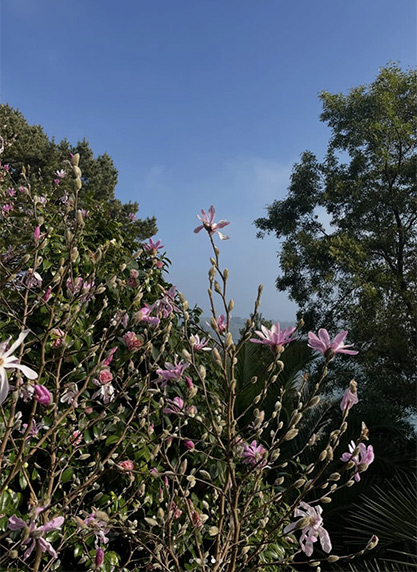
Splashes of colour delight visitors throughout the garden.
The Importance of Tranquillity
As our conversation turns towards the future of horticulture, Robert becomes more reflective. Increasingly, he says, gardens are being encouraged to become wilder. Lawns are left uncut. Formal planting is replaced with meadow-style schemes. Rewilding has become one of the dominant conversations in modern horticulture. Robert is careful not to dismiss it.
“I don’t see why the two can’t live side by side,” he says. Yet there is a note of concern in his voice. His fear is not that wild gardens will flourish, but that cultivated gardens may quietly disappear. “I think gardens need to be places where one can find serenity and peace.” The word serenity comes up repeatedly during our conversation. For Robert, a garden should offer something increasingly difficult to find elsewhere: a sense of escape from the pressures of modern life.
“I think the modern word is wellbeing,” he says. “That one can wander in the garden and have this feeling of wellbeing, that the world is not pressing in on you.” He worries that certain aspects of traditional garden design are already being forgotten. “If you read the old books on garden landscaping,” he says, “never a straight line was the adage.” The old designers understood something fundamental, he believes. Curving paths slow people down. Hidden corners encourage exploration. A partially concealed view can be more powerful than one immediately revealed.
“I love what I would call intimate gardens,” he says. “Where you wind down paths, you come to vistas, you go through an archway, you find some new vista around each corner.” Looking around Lamorran, it is difficult to disagree. The garden unfolds gradually. Nothing is presented all at once.
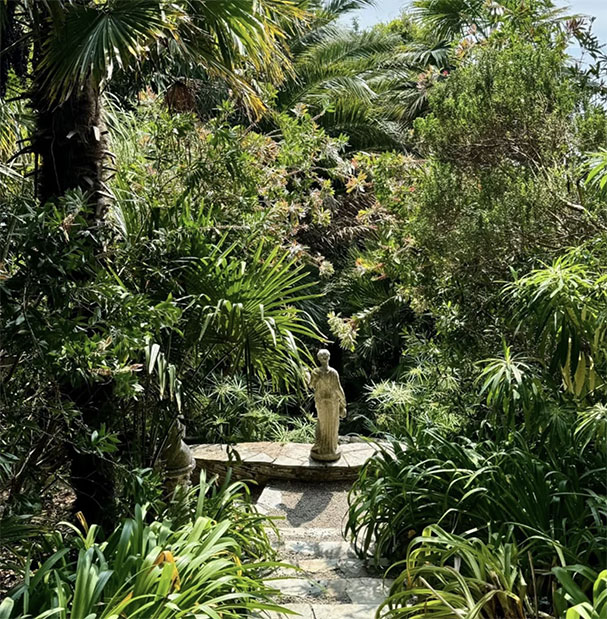
Fascinating planting and serene spaces reveal themselves at every turn.
Hard Work and the Future Gardener
If Robert sounds romantic about gardens, he is considerably less romantic about gardening. The distinction matters. Creating beauty, he says, requires work. “My parents were very keen gardeners,” he says. “They taught me that nothing is achieved without hard work.”
For all the technological advances available to gardeners today, he remains unconvinced that there is any substitute for getting one’s hands dirty. “When people say, ‘Oh, I have this, I have that, to cut down on the hard work,’ that’s fine, it helps. But at the end of the day, you still have to go in the garden and you still have to work.” Then comes the line that feels most revealing of all. “And that should be part of the enjoyment.” The statement sits somewhat at odds with a culture increasingly obsessed with convenience.
For Robert, gardening is not a lifestyle accessory or a design exercise. It is a practice. Something learned through repetition, observation and effort. When asked what qualities the next generation of gardeners will need, he talks less about specialist knowledge than fundamentals. Gardeners, he says, must be adaptable. They must understand soils. They must learn how plants behave. Above all, they must be willing to do the work.
As an example, he points towards the gravel paths running through the garden. The paths appear effortless. They are anything but. For them to remain clean and elegant requires constant maintenance. Weeds must be removed. Edges must be kept sharp. Surfaces refreshed.
He speaks enthusiastically about mulch, a subject many people would struggle to make interesting. Yet listening to him, it becomes clear that this is precisely how gardens are sustained: not through grand gestures, but through thousands of small acts of care. “Mulch,” he says, “is something every gardener should learn about.” It keeps moisture in the soil, suppresses weeds, protects roots from frost and gradually improves soil structure. More than that, it supports an entire hidden ecosystem beneath the garden’s surface. In Robert’s world, gardening begins with understanding these principles.
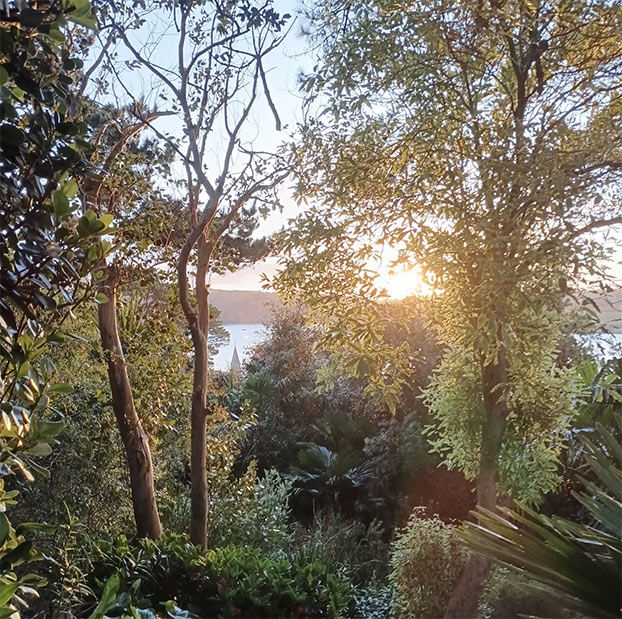
The ocean reveals itself in glimpses as you experience the garden.
Don’t Give Up on Cultivated Gardens
For a series focused on the future of horticulture, Robert’s final message feels particularly resonant. “Don’t give up on cultivated gardens.” It is not a rejection of modern environmental thinking. Nor is it nostalgia. Rather, it is a plea for balance. Wildflower meadows have their place. Rewilding has its place. Naturalistic planting has its place. But so too do gardens designed to delight, surprise and comfort. Gardens where paths curve gently out of sight. Gardens where archways frame unexpected views. Gardens where beauty has been carefully considered rather than left entirely to chance.
Forty-five years after first arriving on this hillside above St Mawes, Robert is still adding to the vision that began as a sketch in his desk drawer. The garden continues to evolve, as gardens always do, but the philosophy behind it remains remarkably consistent. A cultivated garden, he believes, is more than a collection of plants. It is an act of optimism. A place where beauty, tranquillity and human imagination can still work together, and in an increasingly noisy world, that may be more important than ever.
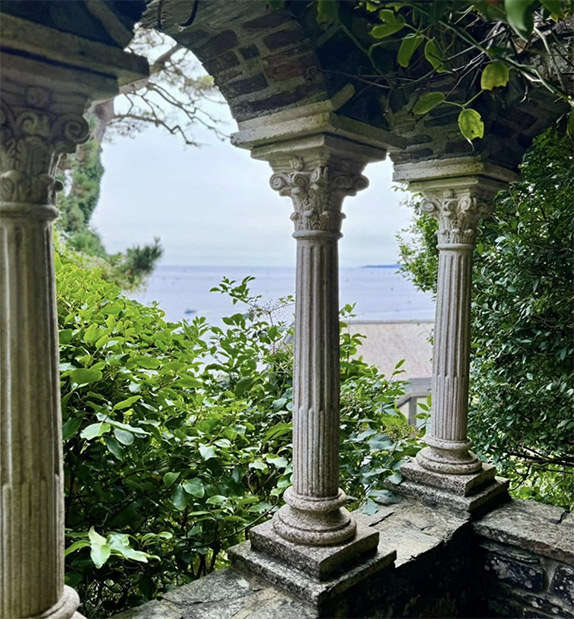
Lamorran is an Italian inspired paradise overlooking the sea.