
There is something otherworldly about being in the biomes at the Eden Project before the masses arrive.
I have never considered the domes to be small, but without the steady procession of visitors winding their way along the paths, the space feels monumental. The vast steel ribs disappear into the canopy of tropical foliage hanging in humid air overhead, and every pathway seems to lead towards some distant corner of the world. There is birdsong, the hiss of irrigation, and the occasional rustle of leaves, but otherwise a stillness that feels bizarre in a place visited by hundreds of thousands of people each year.
The Eden Project has always been an ambitious idea. Built within the scarred landscape of a former china clay pit near St Austell, it transformed an industrial void into one of the most recognisable horticultural destinations in the world. Twenty-five years after opening, the site is flourishing as a non-profit visitor attraction and a living experiment in how plants, people, education, and environmental stewardship can coexist.
Peter Jones, Director of Horticulture at The Eden Project, occupies a role that sits somewhere at the centre of that mission. Responsible for the horticultural teams who care for the biomes, outdoor gardens, and wider landscapes across the site, he oversees everything from tropical rainforest planting to ecological restoration projects. Yet despite managing one of the most extraordinary collections of plants in the country, his own route into horticulture began at home.
“I left school and didn’t really know what I wanted to do,” he tells me. “But I knew I loved being outside.”
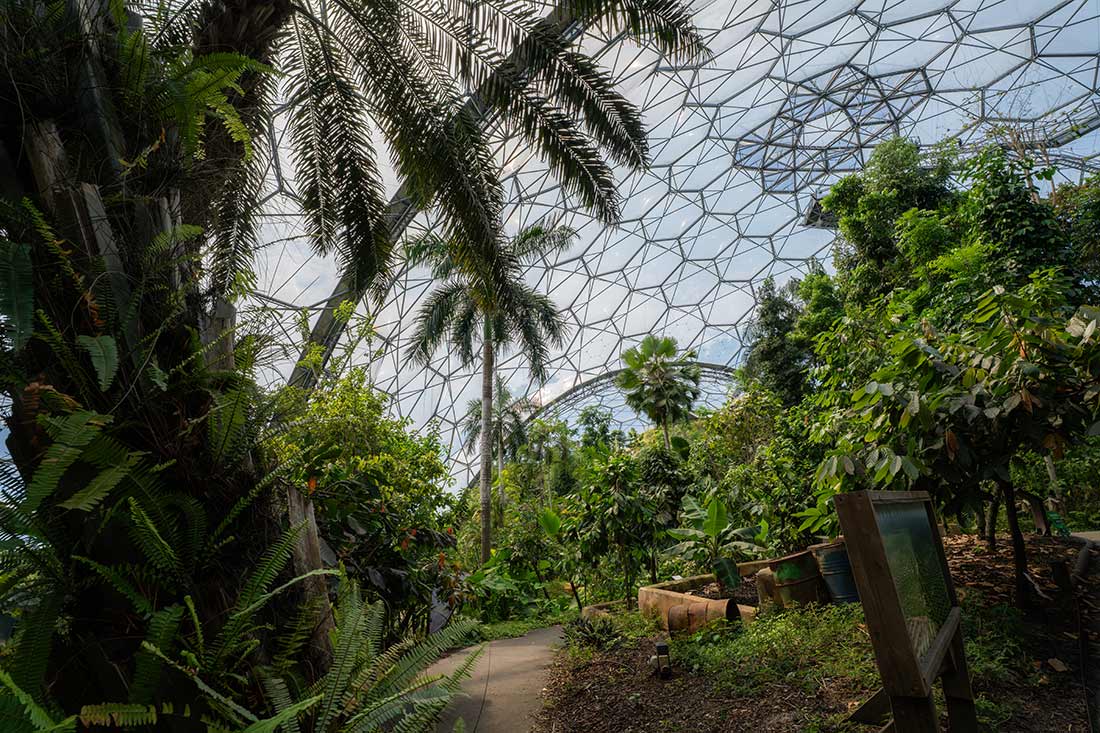
Lush tropical plants flourish in the Rainforest Biome.
Rooted in the Family Garden
Long before he found himself responsible for rainforest trees and Mediterranean landscapes beneath vast geodesic domes, he was gardening alongside his grandparents, helping to grow vegetables and learning the rhythms of the seasons in an ordinary family garden.
“We had a huge vegetable garden,” he smiles. “We’d have vegetables every day of the year. I remember helping my grandad prepare runner beans, which I still hate to this day.”
There was also a small patch of ground that became his own. “It was actually an old driveway,” he says. “We used to plant potatoes there and every time we dug them up we’d get potatoes, cobblestones, and more potatoes.”
What began as childhood curiosity gradually developed into something more serious. Family trips often involved visits to nurseries and garden centres, where a young Peter would return home with conifers, roses, and whatever else happened to catch his eye. By the time he was fifteen he had taken a job at a local nursery, learning not only how to grow plants but also how horticultural businesses function behind the scenes.
Looking back, there is one particular project that still gives him satisfaction.
“I bought a lot of apple trees when I was fifteen or sixteen and planted them in what had been an old goose run,” he grins. “They’re still there now, twenty-five years later. It’s nice to see them and think they’re still doing their thing.”
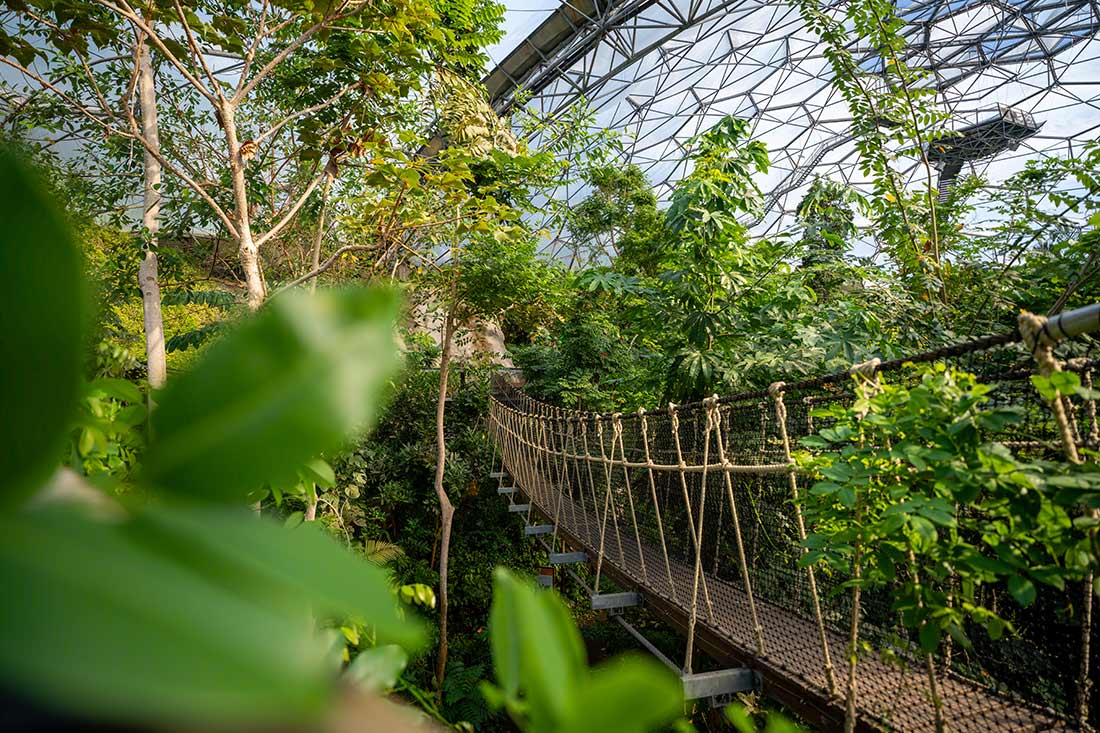
A suspended rope bridge runs through dense greenery inside the Rainforest Biome.
Where It Begins
That sense of continuity seems to underpin much of Peter’s thinking about horticulture; gardens reward patience. Trees outlive plans, and work done today often reveals its value decades later.
After studying horticulture at agricultural college, Peter moved through a series of increasingly specialised roles, working in estate gardens before securing a place on the prestigious diploma programme at Wisley, a Royal Horticultural Society garden in Surrey. Whilst there, a major glasshouse development sparked his interest in growing tender and exotic plants under controlled environments, a fascination that would shape much of his future career and eventually bring him to the Eden Project. Throughout that journey, however, he believes the most valuable thing horticulture gave him was not any single technical skill but an appetite for learning.
“The great thing about horticulture is that people want to share knowledge,” he says. “People are incredibly generous with what they know.”
Gardening may appear simple from the outside, but beneath the flowers and foliage lies an extraordinary breadth of specialisms. Production horticulture, propagation, plant science, landscape design, ecology, conservation, soil health, arboriculture, education, wellbeing, biodiversity, and environmental management all sit beneath the same broad umbrella.
“The wonderful thing about horticulture is that it covers so many different disciplines,” Peter explains. “You can’t really define it as one subject.”
For that reason, he struggles to identify a single quality that future gardeners should possess. Instead, he returns repeatedly to the word “Curiosity”.
“I think it’s about constantly being curious,” he says. “Being adaptable and being open to new ideas, because there is always more than one way of doing something.”
Gardening on the Frontlines of Climate Change
That willingness to keep learning may prove particularly important as horticulture faces a future increasingly shaped by environmental uncertainty. Gardeners witness climate change at close quarters. They notice shifting flowering times, changing rainfall patterns, new pests, warmer winters, and increasingly extreme weather events long before such changes appear in statistics and reports. Even under the biomes at The Eden Project.
“I think gardeners are probably among the first people to notice how quickly the environment around us is changing,” Peter says.
During his own career he has watched weather patterns become less predictable and seasonal expectations grow increasingly unreliable. Wetter winters, hotter summers, prolonged dry spells, and intense rainfall events all influence how gardens are designed and managed.
At the same time, scientific understanding of the natural world continues to advance at remarkable speed. New discoveries about soil ecology, fungal networks, microbial relationships, and ecosystem function are transforming how horticulturists think about the landscapes they manage.
“We know a fraction about what’s happening below ground,” Peter says. “But our understanding is increasing all the time.”
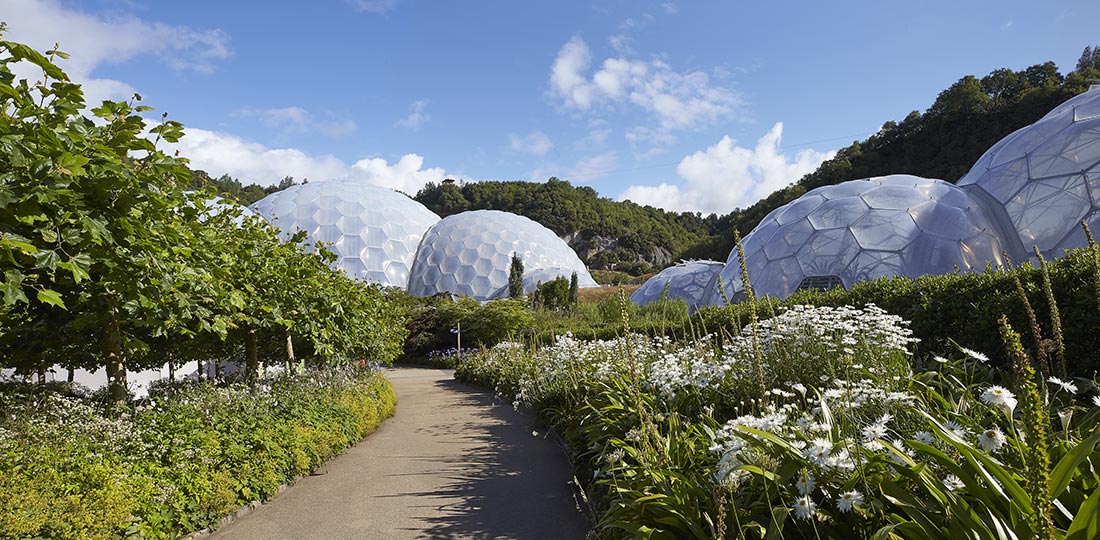
Flower-filled pathways lead towards the Eden Project’s biomes
Working With Nature, Not Apart From It
For him, the future of horticulture lies in combining practical experience with emerging knowledge, while recognising that people themselves are not separate from nature. “There needs to be a change in mindset,” he says. “The natural world and us aren’t separate things. We are part of it.”
That philosophy runs through much of the Eden Project’s work. Sustainability, regeneration, biodiversity recovery, and environmental education are not treated as separate initiatives but as interconnected aspects of the same challenge. One of the site’s most powerful lessons is visible in the landscape itself. The Eden Project exists because a group of people looked at an exhausted industrial clay pit and imagined something different.
“When people talk about motivation and action,” Peter says, gesturing around the biome, “this entire place came from an idea and the motivation to actually do something about it.”
The former quarry, once stripped bare by extraction, now supports thousands of plants from across the globe and welcomes visitors from every corner of the world. Its very existence serves as an argument for optimism.
If a clay pit can become a rainforest, perhaps other transformations are possible too.
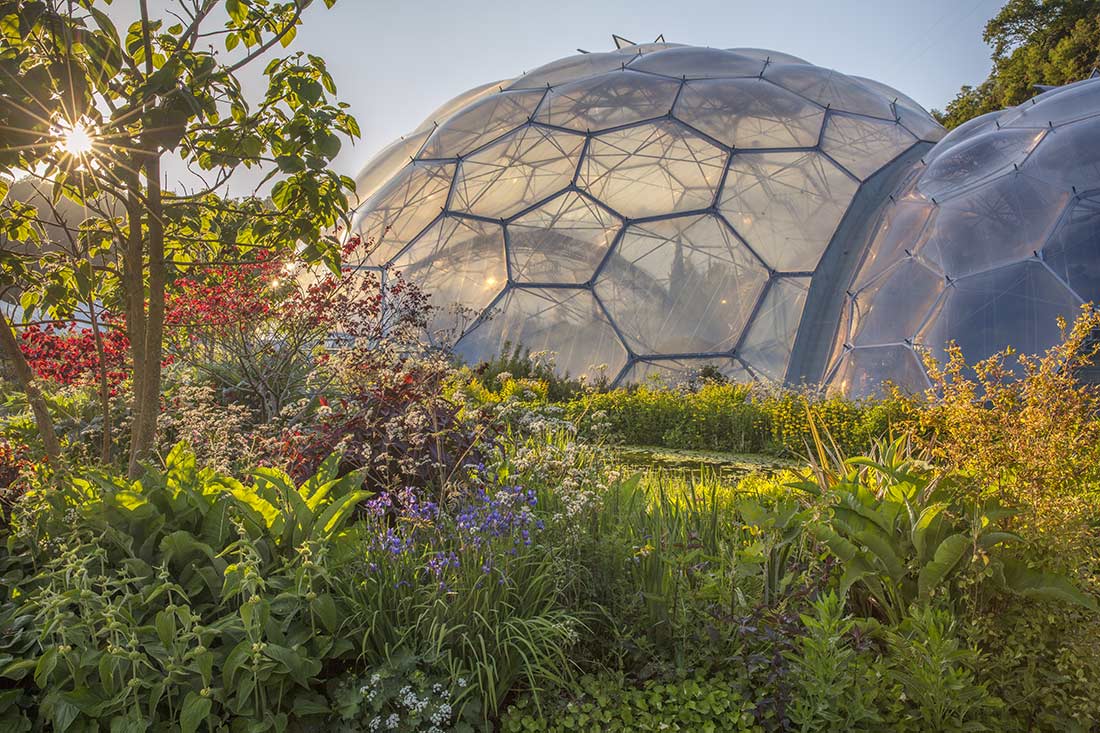
Vibrant outdoor gardens surround the iconic biomes in the Cornish sunshine.
A Future Taking Root
Alongside its horticultural displays, the Eden Project has become an important centre for education and skills development, working with colleges, apprentices, trainees, and volunteers who may represent the next generation of gardeners, growers, designers, and environmental practitioners.
Peter speaks warmly about the volunteers who contribute their time across the site and about the importance of creating opportunities for people to engage with horticulture regardless of their background or experience.
“You’ve got to have the motivation to do something,” he says. “Motivation for action is where it all begins.”
For Peter, horticulture’s importance extends far beyond gardens themselves. It has implications for biodiversity, public health, education, climate resilience, food production, and community wellbeing. It shapes how people experience the natural world and how they understand their place within it.
“I think horticulture plays an incredibly important role,” he says. “It needs to feed into everything from education to how we think about our environment.”
Outside, the green-jacketed staff are starting to move a little quicker as we near the time visitors will arrive. The pathways that felt cavernous and silent an hour earlier are about to fill with energy and an enquiring joy, and the biomes will begin to perform their intended purpose once again.
Perhaps that is the Eden Project’s greatest achievement. More than the cultivation of remarkable plants and the regeneration of a former industrial landscape, it cultivates curiosity itself. Beneath the domes, surrounded by living collections from around the world, visitors are invited to imagine what might be possible across the globe, if mankind were to work with nature, rather than against it.