On a bright and windy May morning, Charles Williams hammers the throttle on the 4×4 buggy and hurtles us up the hillside and through the swathes of rich green leaf shuddering in the sea breeze…
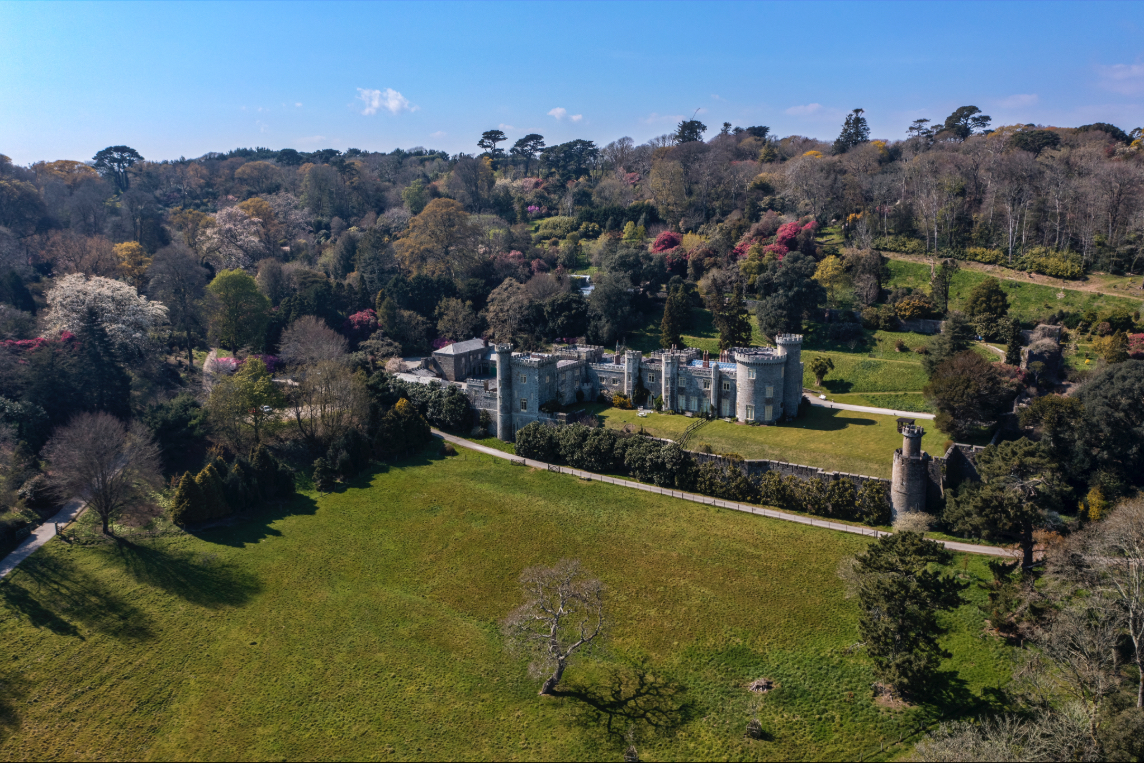
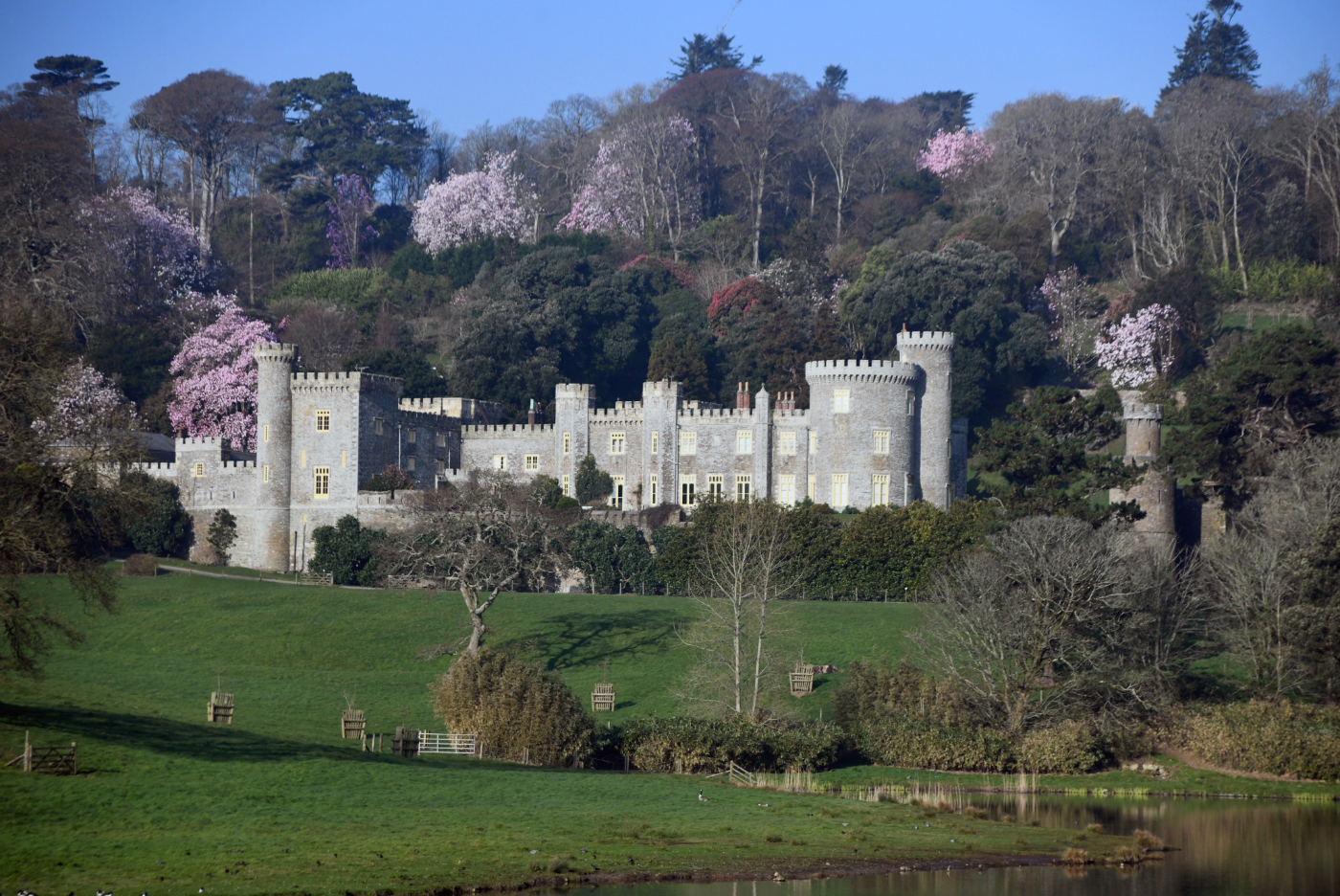
In early spring, the face of the hill at Caerhays is covered in pinks, whites, and purples but now, as summer pre-emptively edges across the southernmost county of England, Caerhays is a lush and verdant green. Every tree on the estate bristles with fresh leaf growth, creating a canopy of dappled light over the 140 acres of sloped, winding pathways.
Charles’ family have been the custodians of the Caerhays Estate for more than 170 years, and Charles was born to horticulture. The estate is his birthright, and the magnolia collection at Caerhays is his life’s work. From a very young age, Charles has had deep roots in the world of plants.
Photograph courtesy of Caerhays Estate
Microscopes and Daffodil Hybrids
“I had my first garden when I was five,” says Charles. “I grew Sweet William, and sweet peas, and daffodils which I actually crossed myself.” Though he adds that his naive hybrid wasn’t good enough to warrant naming.
“As children, my brother and I wandered about with a microscope,” he adds. They gathered seeds in the same way other children collected football cards. They hunted for rhododendrons they could create hybrids with, knowing that those with hairs on their leaves couldn’t be crossed with their bald relatives.
As the young Williams boys explored their burgeoning interest in horticulture, their great grandfather worked hard, with the help of the then-Head Gardener of Caerhays, to create new species that could help struggling farmers over winter. In 1897, J.C. Williams and his daffodil gardener Mr. Gregory successfully hybridised daffodil varieties that would bloom during midwinter.
“The aim was to create daffodils that would flower out of season before Christmas, and thereby create a market for the smaller farmers who had a very rough time,” explains Charles. “The idea was that all small farmers could then have half a field where they would grow daffodils, cut flowers, that flower before Christmas.”
Charles adds that Tresco Island was one of the locations that benefitted from his great-grandfather’s hybrids and by 1895, Tresco had sold £10,000 worth of cut daffodils.
The story of Caerhays is, in many ways, the story of British horticulture itself: plant hunting, experimentation, empire, commerce and an all-encompassing love of plants braided together across generations. What distinguishes the Williams family is not simply that they inherited one of England’s great gardens, but that each generation appears to have approached it less as owners than as stewards of a living archive.
“Crossing was something we very much grew up to between school and university,” explains Charles. “I became a student gardener at Windsor Great Park under John Bond, who was the curator of the gardens there, so I worked in the Valley Gardens and the Savill Garden for a year.”
That formal grounding sharpened instincts already deeply ingrained. By the time Charles returned to Cornwall, horticulture had become not merely a passion but a vocation. Alongside the estate, he helped build Burncoose Nurseries into one of Britain’s leading specialist plant nurseries, known particularly for rare trees and shrubs and for introducing unusual species into cultivation.
“I used to collect fuchsias in my teens, and was very proud when I won my first cup in 1974, from the League of Cornwall Fuchsia Society,” Charles says, smiling at the memory.
Photograph courtesy of Caerhays Estate
The Caerhays Magnolias
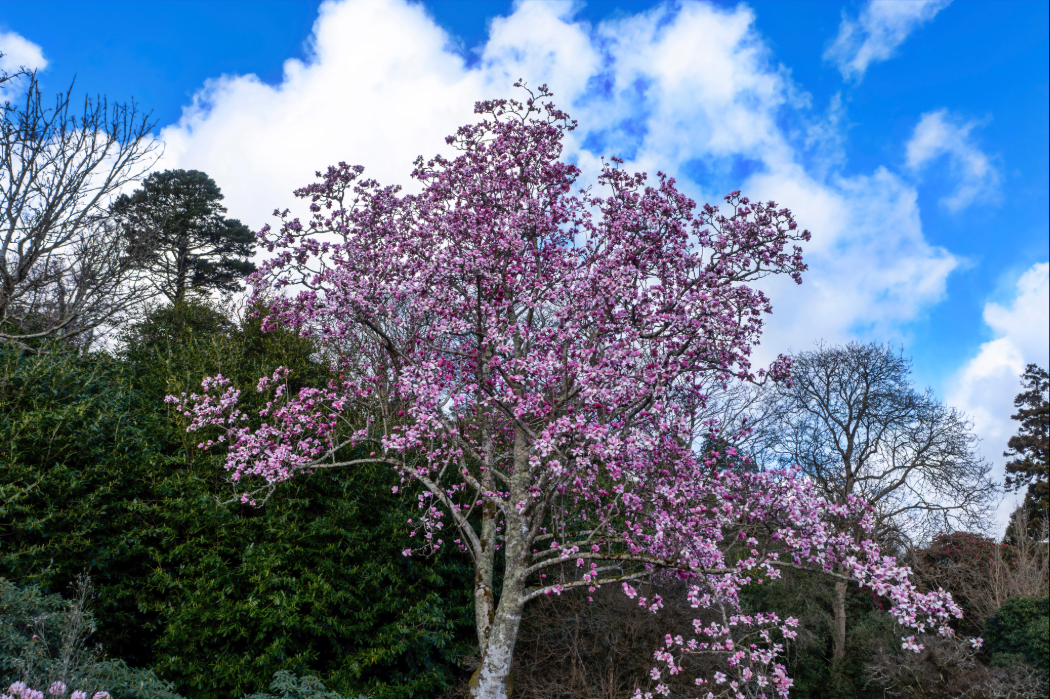
To walk through Caerhays in spring is to understand why magnolias inspire a kind of evangelical devotion among plantsmen. Before the leaves emerge, the trees erupt into furious bloom. Chalices of cerise, ivory, shell pink and the deep purple of plum jam are suspended against bare branches. Some flowers are the size of dinner plates. Others hang like lanterns over the paths.
At Caerhays, magnolias are not decorative additions to the landscape; they are the landscape itself.
The collection has been shaped over more than a century, beginning with the great plant-hunting expeditions to China funded by Charles’s great-grandfather, J.C. Williams. Seeds gathered by explorers such as Ernest Wilson and George Forrest arrived in Cornwall in wooden crates after journeys that had, in some cases, nearly cost the collectors their lives. Many of those original introductions still grow on the estate today. Charles inherited both the trees, and also the restless impulse to improve upon them.
He formally took over management of the estate in 2015, though by then he had already spent decades hybridising magnolias, rhododendrons and camellias, patiently raising seedlings whose full potential might not be visible for well over a decade.
“Not everything is a success, of course, you find that a cold winter takes things out, you find that a hurricane or two,” concedes Charles. “I’ve had two hurricanes to contend with in my lifetime, and in the garden here they have created a lot of space we didn’t expect to have for new planting.”
According to Charles, a garden like Caerhays is hard-won. These kinds of gardens are a historic collection of plants which, in some cases, people have risked their lives across the globe to collect. Many of the seeds that grew into the trees that populate the Caerhays Estate were gathered from the furthest reaches of the planet a century ago.
“Some plants are extraordinarily rare and very threatened in the wild,” explains Charles. “So part of the job is not just to indulge in new things, but it’s also to propagate by layering, or by taking seed, or by grafting, or cuttings, or whatever, to ensure that the species survive.”
The 120 to 130 different species of Magnolia tree are a testament to Charles’ careful cultivation and hybridisation, alongside at least 800 named magnolia varieties growing at Caerhays today, many of which were crossed and bred by the Williams family.
“With a magnolia hybrid, it could be 12 to 15 years before you would see a flower,” adds Charles. “And very often you wait all that time, and you’re disappointed. Other times you have created something that’s genuinely new, can be registered with the RHS or Magnolia Society, and you then put a name to it, then you propagate it, and if it’s really good, there’s commercial markets.”
Hybridisation, Charles explains, is equal parts science, instinct and patience. The goal is rarely novelty for novelty’s sake, more often it is just refinement.
“You might be aiming for a different colour, you might be aiming for a plant that grew much better in smaller gardens,” says Charles. “You might be aiming for something that would flower a bit later in the year.”
Late flowering can mean survival in unpredictable weather. Compact growth can make a plant suitable for urban gardens. Colour, scent, vigour, disease resistance – these are all variables sought when creating new varieties.
“It’s a bit like stamp collecting,” Charles says. “There is always another plant that you’ve never seen before.”
Behind him, through the window of the shed where we sit, vibrant leaves jostle in the breeze across the reaching arms of many mature trees.
“There are tens of thousands of plants in the context of trees and shrubs that we’ve grown here, excluding wild plants and excluding herbaceous plants,” he continues. “And getting to know them, getting to grow them, finding new ones – that is the most exciting thing that you have in horticulture. That’s really what drives me to grow and expand the garden, as I have done by 40 acres in the last 20 years.”
The romantic image of the gentleman hybridiser obscures the sheer volume of failure involved. Most crosses disappoint. Many cuttings die. Seedlings collapse after years of promise. Success depends as much on observation as expertise.
“Science comes into it, but actually it’s really local knowledge,” notes Charles. “The reality is that if you’re growing these very rare plants, there’s a lot of hit or miss. You might try to take a cutting at different times of the year, three years running, and only once will you have success. Now that knowledge is useful, it isn’t particularly scientific, it’s more trial and error.”
For children interested in plants, Charles advocates beginning with the simplest and oldest method of all.
“Seeds are the easiest approach to plant propagation or creation,” he says. “Although the germination of a seed is not something that’s instant, it’s something that is quick enough to be able to be appreciated.”
“Seeds are a great way to encourage a youngster to develop an interest in horticulture,” he adds. “Which is why I’m so pleased with the project the Great Gardens is doing with the sunflower seeds for children.”
Photograph courtesy of Caerhays Estate
More than 100 Years of the Garden Diary
Long before climate change became a scientific discipline or gardeners began discussing “phenological shifts,” the Williams family were recording the seasons by hand.
According to Charles, great horticulture begins with attention: the ability to notice subtle distinctions between species, to recognise patterns in flowering times, leaf growth and weather. But observation alone is not enough. It must be paired with study, memory and record.
At Caerhays, that impulse produced one of the garden’s most remarkable inheritances: a diary kept continuously since the late nineteenth century.
“The garden diary is a book. Originally, it was a book started in about 1897 by my great grandfather, and there was a page for each day of the year,” says Charles. “On each page is the year, the date, and listed what was thought to be significant or interesting in the garden that day.”
The diary charts flowering dates, weather events, planting successes, unusual blooms and botanical arrivals from overseas expeditions. It is at once practical document and family chronicle.
“Some of it is quite difficult to read, as a lot of it relates to plants coming from China which didn’t have a name, or the name has been changed not once, but twice,” he admits. “My great uncle and my father kept up that diary, and so did I when I moved to live here.”
“In 2015, I decided to have it all typed and put online,” says Charles. “We also now include ten or a dozen pictures of plants a day. I still keep the book as well and we’re now onto volume two of the actual diary. I keep the diary going in my own fair hand and haven’t missed a day in 10 years.”
The result is an extraordinary long-view horticultural record, not compiled by scientists in laboratories, but by gardeners walking the same hillsides year after year.
“You can look back over the years and ask: when does the first snowdrop come out? When does the first magnolia come out?” says Charles. “Last year we had magnolias out in January, which may sound shocking, but in January of 1897 Magnolia stellata flowered on Christmas Day.”
The diary reveals both continuity and instability: patterns repeated across generations, interrupted by unpredictable weather, and some seemingly random anomalies.
“As a child I kept lots of records of wildflowers,” Charles adds.
For young people hoping to enter horticulture today, Charles insists that enthusiasm and an eye for detail must be matched with practical training.
“You need to do your RHS apprenticeships, and that would involve working in a nursery or in a garden center or in a garden that has hort facilities,” he says. “The biggest problem for people is to get their plant knowledge up to a level where they can actually make a useful contribution.”
Listening to him speak, I suspect that plant knowledge alone is not enough. What sustains a garden like Caerhays over generations is something more elusive: curiosity, patience, and the willingness to devote decades to work whose fullest results may only flower long after you are gone.
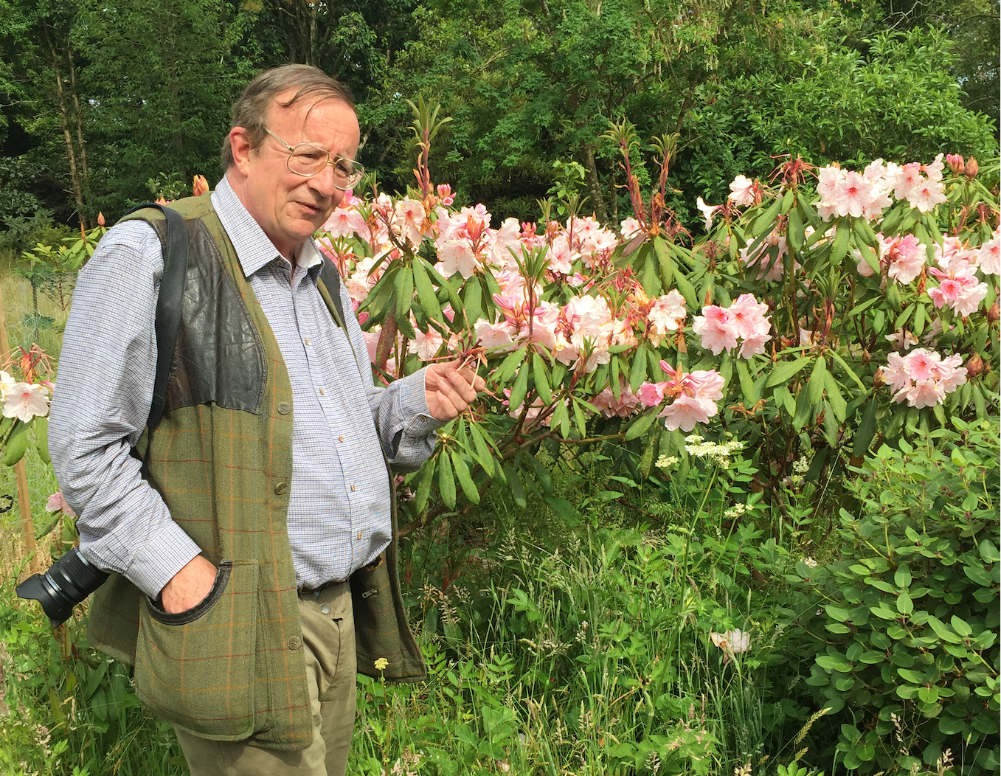
Photograph courtesy of Caerhays Estate