In June, it should be the height of summer at Bonython. Summer flowers are everywhere across the estate in swathes of purple, pink and white, but the entirety of the hillside, deep into the valley, is sparkling with moisture. Low, ethereal clouds sway over the lawns and the palms, while horse chestnut trees and giant gunnera emerge from the mist in a strange and magical procession.
Bonython sits only a stone’s throw from the broad, flat sprawl of Culdrose, where military helicopters rise and fall with mechanical regularity, yet within the protective fairy ring of mature trees and exotic planting it feels a world away.
The weather here seems to operate according to its own logic. Clouds drift low through the valley, rain arrives in soft veils rather than storms, and ponds appear and disappear behind curtains of mist. The effect is strangely transporting, as though the garden exists in a small climate pocket of its own, suspended between Cornwall and elsewhere.
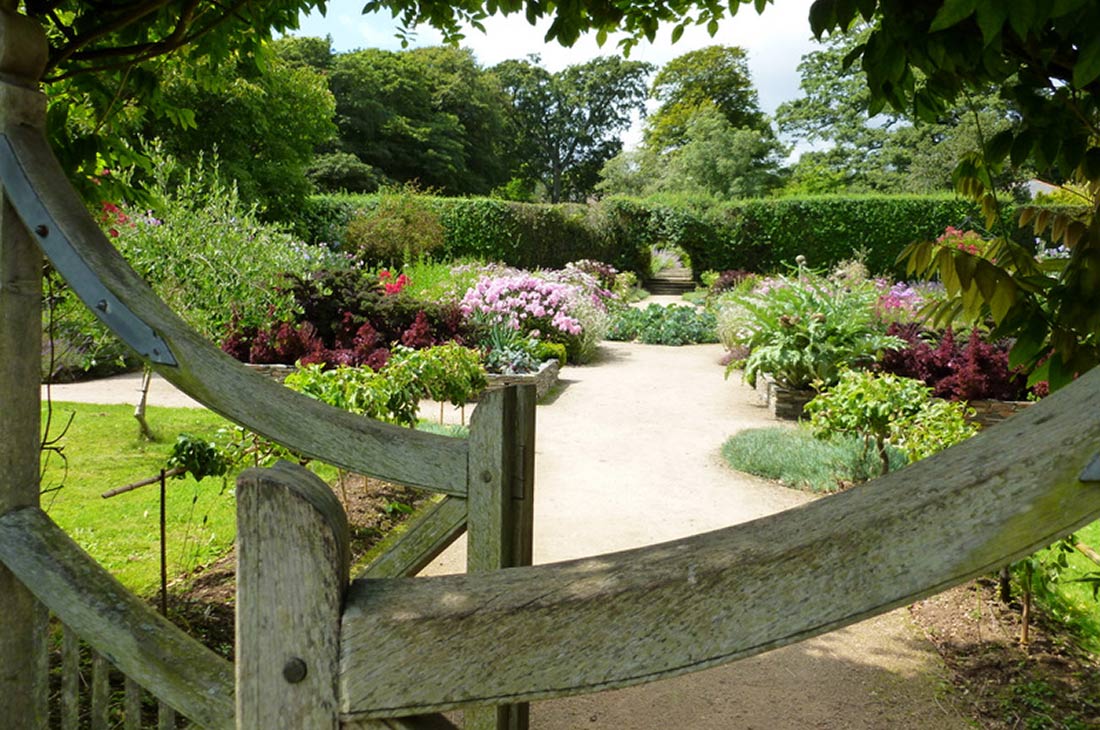
A rustic wooden gate opens onto the beautifully planted walled garden.
The Creation of a Canvas
A quarter of a century ago, much of what exists today was still only an idea. “We bought the estate 25 years ago,” says Sue Nathan, owner of Bonython Estate Gardens. “And we’ve been on a journey of creating the garden ever since.”
What followed was not the execution of a rigid horticultural masterplan, but a gradual process of observation, experimentation and learning, undertaken by somebody who freely admits that she arrived with far more enthusiasm than horticultural expertise.
“I didn’t know much about gardening,” Sue says cheerfully. “But through looking at gardens, reading about gardens, and seeing what worked and what didn’t, I learned.”
The garden that has emerged over the intervening decades reflects that education. It is also, unmistakably, the work of somebody whose primary fascination lies not in the pursuit of rare plants for their own sake, but in atmosphere, composition and emotional response. Again and again, Sue talks about colour, about impact, about the feeling a visitor experiences when they enter a space. Plants matter enormously, of course, but largely because of what they allow her to create.
The result is twenty acres divided into a succession of distinct yet interconnected worlds. There are lakes edged with exotic planting, herbaceous borders alive with pollinators, avenues of flowering trees, woodland walks and broad sweeps of colour organised with the eye of somebody thinking less about individual specimens than the wider picture they create together.
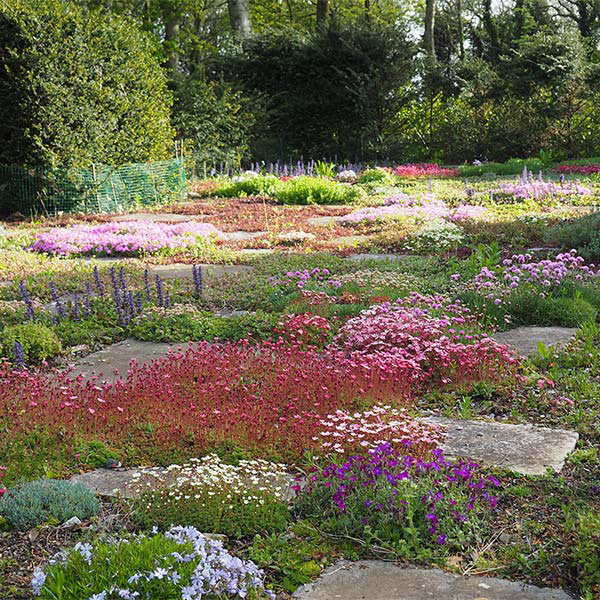
A colourful tapestry of low-growing flowers spreads.
Painting with Plants
Sue’s first major ambition was to create a South African-inspired garden in the valley.
“Originally I decided I was going to bring South Africa to Cornwall,” she says.
Born in South Africa, she was drawn to the bold colours and dramatic planting she remembered from childhood, and one of the lakes became the setting for an ambitious experiment in recreating some of that atmosphere in Cornwall.
At first, she planted proteas. “They flourished for five years,” she says. “And then they turned their noses up.”
It is a phrase she delivers with amusement rather than frustration, because if there is one lesson gardening appears to have taught her, it is that the plants always have the final say.
“You learn through mistakes,” she explains. “You have to plant what is happy to grow. It’s no good seeing something somewhere else and deciding you’re going to have it if it doesn’t want to grow where you are.”
Today, the South African garden relies less on stubborn optimism and more on plants that genuinely enjoy the conditions at Bonython. Agapanthus, cannas, restios and alstroemerias provide the late-summer spectacle Sue originally envisioned, creating dramatic drifts of orange, red and yellow at precisely the point in the season when many gardens begin to lose momentum.
What quickly becomes apparent when walking through Bonython is that Sue thinks in broad brushstrokes. Plants are rarely deployed individually. Instead they appear in great swathes and repeated groupings designed to create impact across considerable distances.
“If it’s going to have an impact, you’ve got to be bold,” she says. “You can’t do five little plants. You’ve got to do twenty-five.”
The philosophy extends throughout the estate. Cornus trees are planted in groups so their flowering can be appreciated from afar. Ornamental grasses are chosen not simply for colour but for movement and texture. Long-lasting performers are generally favoured over fleeting spectacles, however beautiful those fleeting spectacles may be.
“Peonies are one of my favourite flowers,” Sue says. “But they’re there for five minutes and then they’re gone.” What interests her most is sustained effect. The ability of a planting combination to hold your attention, not for days, but for weeks or even months.
“You want people to walk into a garden and say, ‘Wow, look at this colour.'” Yet colour, for Sue, is never simply decorative.
“You want people to feel emotion,” she says. “You want them to breathe. You want them to feel relaxed. Gardens must move you like a painting.”
As we walk, lacey sheets of rain drift slowly through the valley and settle onto ornamental grasses that sway elegantly in the breeze. Every surface appears animated by movement. Leaves flutter. Seed heads nod. Reflections and raindrops tremble across the water. The entire landscape feels like a living composition that is continually being altered by weather, season and light.
The estate functions as a horticultural gallery, each area carefully composed as its own exhibition, yet the exhibits themselves never remain fixed. Light changes them, rain softens them, and the seasons transform them entirely. Perhaps installation art is not quite the right comparison, performance art feels closer. The grasses provide choreography. The flowers deliver the backdrop. The bees and butterflies are the performers.
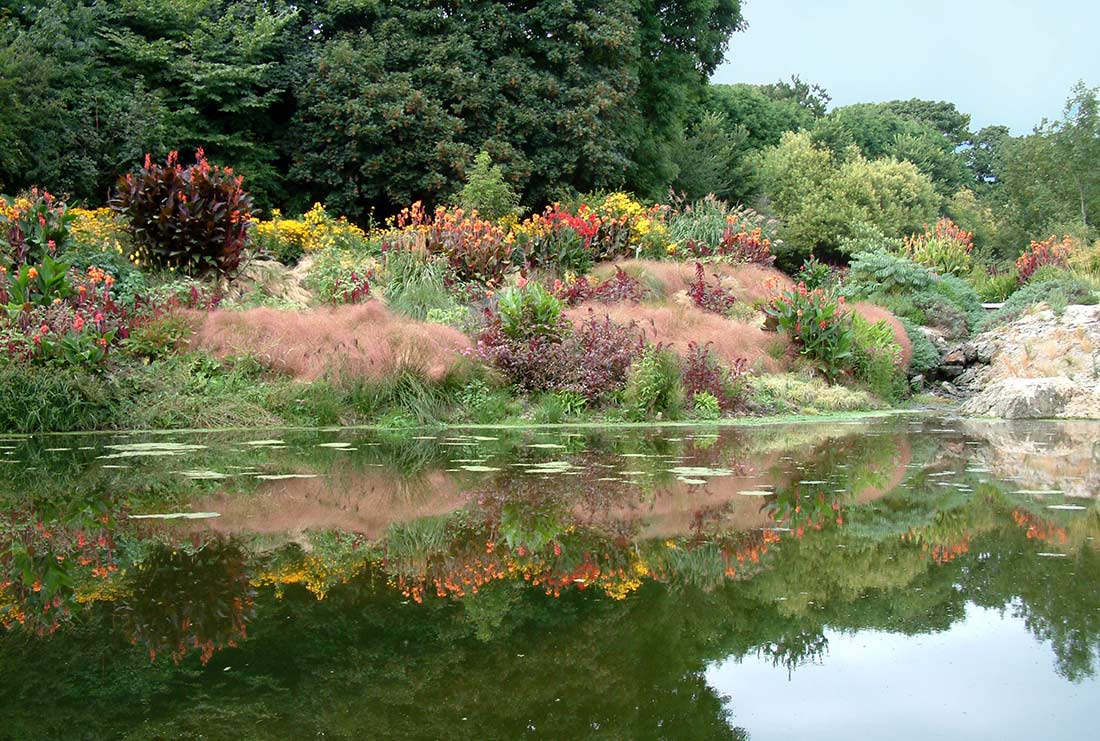
Colourful waterside planting is reflected in the tranquil lake.
Gardens as Places of Wonder
Again and again, our conversation returns to the emotional role of gardens and the increasingly important place they occupy in modern life.
“When people walk into a garden, they should feel peace,” Sue says. “They should feel harmony.”
It is a sentiment that might sound unfashionable amidst contemporary discussions about biodiversity targets, climate resilience and ecological management, yet Sue is not dismissing any of those concerns. Bonython itself contains extensive wildlife-friendly planting, and during summer the borders hum continuously with bees and butterflies. Instead, she is arguing that something else matters too.
The experience of being in a garden, to feel a sense of wonder and have the opportunity to step away from the noise of everyday life and reconnect with the natural world.
Modern garden design has shifted steadily towards naturalistic planting and rewilding, a movement she broadly welcomes, though she is wary of abandoning structure and design altogether.
“There is a place for both,” she says. “You can have naturalistic areas, but you also need colour and design.”
Part of her concern is practical. Most visitors do not have twenty acres at their disposal. They have small gardens, small budgets and limited time. What inspires them is often not a vast meadow but a planting combination, a colour palette, a border or a particular atmosphere that they can take home and recreate in some form for themselves.
What Sue returns to repeatedly is the idea that gardens should inspire participation rather than passive admiration. Visitors should leave with ideas. They should leave wanting to plant something, to experiment, to create.
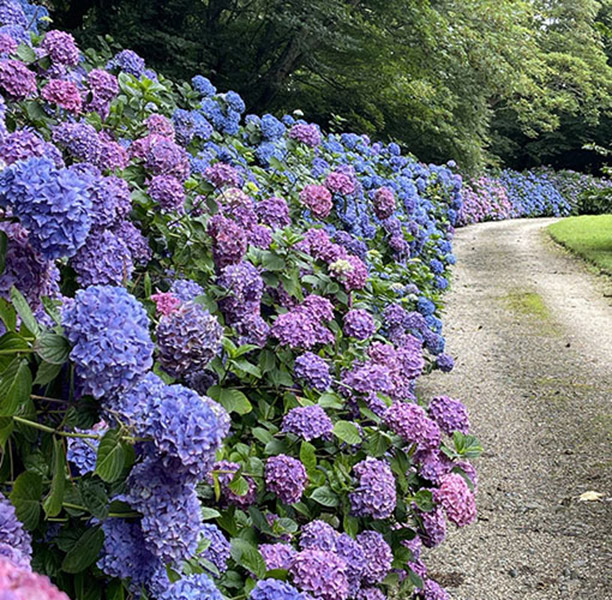
Blue and pink hydrangeas at Bonython.
Inspiring the Next Generation
It is impossible to spend much time with her without noticing how often she circles back to children and young people. While many conversations about the future of horticulture focus on technology, climate adaptation and changing fashions in garden design, Sue is more interested in what gardens can offer as places of discovery.
Children, she believes, need opportunities to become fascinated by the living world. “I think children need to get outside more,” she says.
There is no shortage of opportunities for fascination at Bonython. Throughout the summer months, butterflies dance between borders, dragonflies patrol the lakes and bees move lazily through the herbaceous planting. What appears at first glance to be a carefully curated landscape also functions as a thriving habitat.
Gardens, Sue suggests, offer something increasingly rare. They teach attentiveness.
The simple act of noticing how a flower emerges, watching pollinators move through a border, observing which plants flourish and which struggle, all require patience, curiosity and observation. Those qualities have always been central to horticulture, and perhaps feel more valuable than ever in a world where so much attention is constantly being pulled elsewhere.
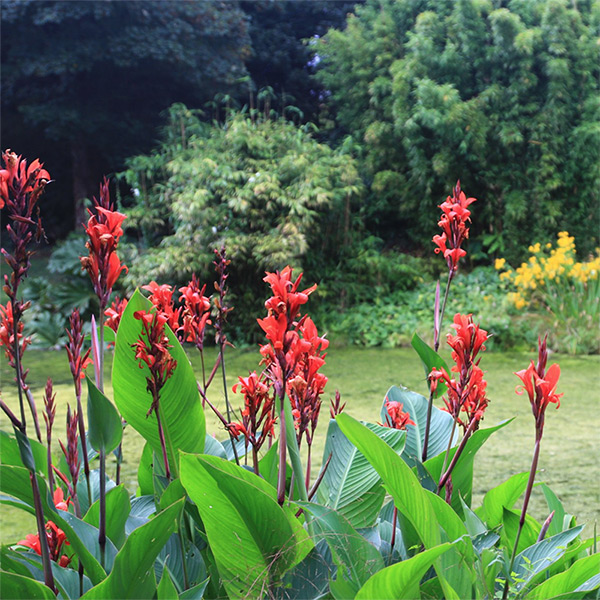
Vibrant red flowers and lush foliage beside the lawn at Bonython.
Learning to See
Like many gardeners, Sue worries about climate change. “The weather has become much harder to predict,” she says.
The old certainties no longer seem quite so certain. Drought arrives when rain is expected. Heavy downpours arrive when conditions should be dry. Gardeners adapt, revise and experiment, only to discover that the conditions have changed yet again.
“No sooner do you decide you’re going to plant for drought,” she laughs, “than you get floods.”
Yet despite these challenges, she remains optimistic. Partly because gardening has always involved adaptation. Plants will fail, and others will succeed. Conditions change, and gardeners respond.
Adaptation, Creativity, and the Future
When asked what qualities future gardeners will need, she immediately begins talking about creativity: “I think they’ve got to be able to visualise.”
Garden design, she argues, requires the ability to look at an empty space and imagine what it could become. It requires colour sense, spatial awareness, curiosity and imagination. Even the smallest garden presents opportunities for creativity if somebody is willing to look carefully enough.
In other words, it requires people to learn how to see and according to Sue, gardening itself can impart that ability. After she began creating Bonython, she took up botanical painting, utterly inspired by the landscapes she had created.
“Gardening came first,” she smiles. “Then came the painting.”
As we continue through the gardens, passing visitors whose faces sparkle with both rain and pure wonder, it’s clear that Bonython is much more than a collection of plants.
On the lake ducklings scatter across a raft of lily pads and underneath the shelter of the giant gunnera. Back up towards the manor, a chapel sculpted entirely from yew emerges through the mist beneath the trees, appearing like a gateway to a fairy world. The entire garden seems to lean into the principle that anticipation can be as powerful as arrival.
Standing beside the water as another veil of rain drifts slowly across the valley, softening the outlines of the trees and blurring the edges of the landscape, it strikes me that what Sue has created at Bonython exists somewhere at the intersection of art and magic.
The garden is carefully designed, meticulously planted and maintained with enormous effort, yet the experience of walking through it feels utterly effortless.
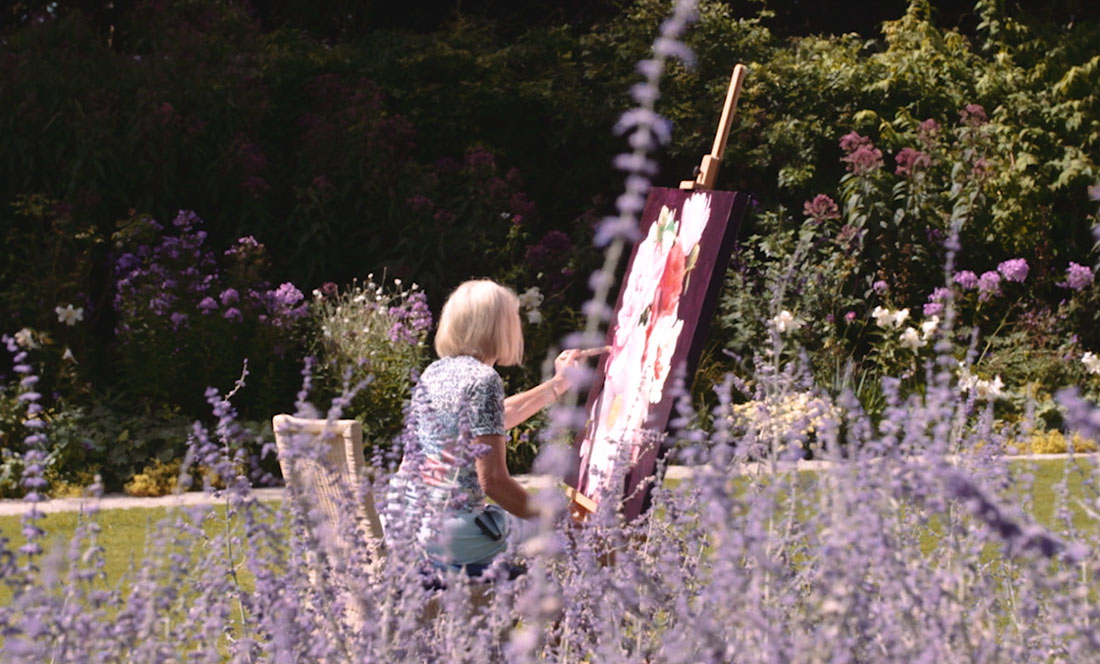
Sue painting in the gardens.