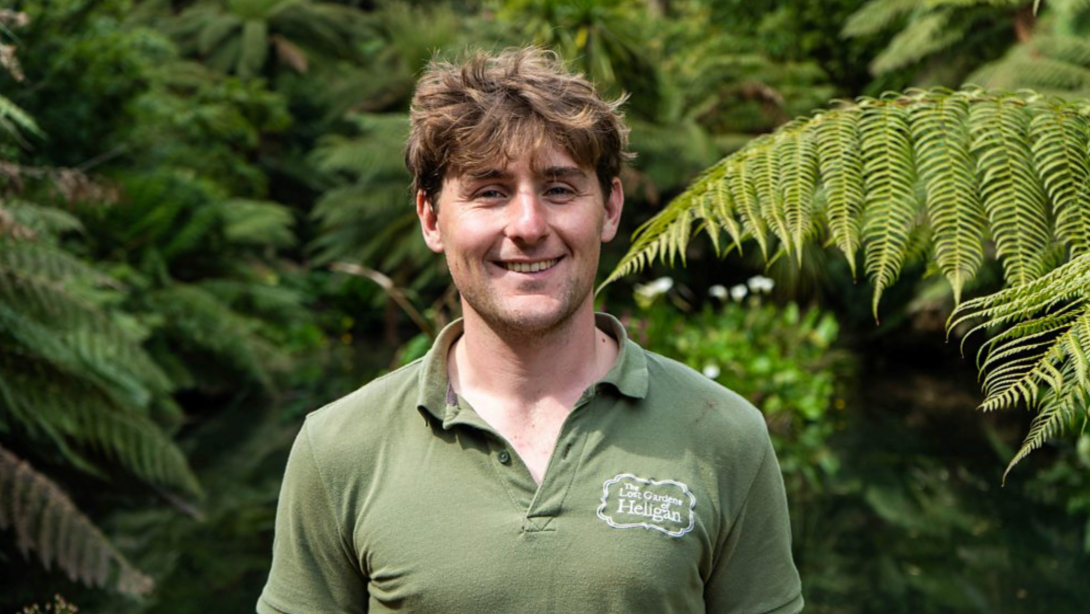
At just 26, Heligan’s youngest-ever Head Gardener is helping to shape a more ecological, educational and inclusive future for horticulture…
In the glasshouse we’re sheltered from the early summer winds. Outside, the neat pathways buzz softly with groups of appreciative tourists beetling along. They nod and smile as they identify pristine examples of Sweet William, Honey Spurge Euphorbia, and purple Wisteria draped like lace over Victorian red brick, shivering in the wind despite the shelter of the walls.
Henry Welch might be the youngest head gardener ever at the Lost Gardens of Heligan, but at 26 he carries himself with the confidence and worldliness of a much older person. Though horticulture is a relatively recent part of his life, it is something that now seems integral to his being.
“When I was a child, I really did not care at all about gardening,” says Henry. “I started doing a little bit of volunteering here at Heligan as a 19 year old, working in the productive garden.”
“My mother was really good at making me get out there and try different careers,” he laughs. Henry grew up in close proximity to the gardens and his mother pushed him to “just give it a go”.
“There were no jobs at the time, so I thought I would just try a bit of volunteering. I kind of just fell into it,” admits Henry. “Initially just using my body and feeling really tired at the end of the day was quite rewarding.” With the roots of inspiration firmly planted, Henry went on to study at Edinburgh Botanic Gardens and Kew before returning and building his career at Heligan.
Unlike many professional gardeners, Henry didn’t spend his childhood collecting seeds or memorising plant names. There were no grand plans to one day oversee one of Britain’s most celebrated gardens, no early obsession with rare species, no family tradition drawing him inexorably towards horticulture.
Today, plants occupy almost every corner of his life. He speaks fluently about conservation, biodiversity, climate resilience and botanical collections, moving easily between practical horticulture and broader environmental questions. “Horticulture is a great career path,” says Henry. “It’s not just a job, it is a vocation.”
Gardens operate according to a logic that is often at odds with the wider world. Plants cannot be hurried, trees mature over decades, and success is measured season by season. Working within those rhythms requires a particular mindset, one that Henry seems to have embraced completely. “There’s something quite grounding about working in horticulture,” he explains. “You’re forced to just take a step back and have that pace slowed down because we are very much dictated by seasons.”
Outside the glasshouse, visitors continue to drift through the gardens in small clusters, pausing to photograph blooms or lean closer to inhale scent and admire bees. Many have travelled considerable distances to visit Heligan, drawn by its extraordinary story of loss and rediscovery. Few, perhaps, arrive expecting to encounter a head gardener who belongs to a generation more commonly associated with smartphones than secateurs.
Henry represents something increasingly important within British horticulture: a new generation of gardeners inheriting established historic landscapes and finding themselves having to prepare them for a rapidly changing future.

Growing Future Gardeners
One of the challenges occupying much of Henry’s attention has less to do with plants than people.
Across the horticultural sector, concerns are growing about an ageing workforce and a shortage of young people entering the profession. Experienced gardeners are retiring. Skills built over decades risk being lost. At the same time, horticulture remains curiously absent from many conversations about future careers, despite sitting at the intersection of ecology, food production, environmental science, conservation and landscape management.
Henry believes the problem begins long before young people make career decisions.
“There’s definitely a systemic problem within the school system,” he says. “It was always my experience in school that you only got to go outside the classroom and be out in nature if they didn’t deem you to be clever enough to move on to do A-levels.”
For a profession increasingly shaped by climate science, ecology and conservation biology, horticulture continues to battle perceptions that it is somehow less rigorous than more traditionally academic pathways.
Listening to him speak, it becomes clear that education is not simply another part of the job. It sits at the heart of how he imagines the future of the industry.
Heligan’s Nature Futures programme has become one of the principal vehicles for that ambition. Designed to engage visitors of all ages with the natural world, the initiative stretches from early-years education through to adult learning, creating opportunities for people to encounter horticulture not simply as a hobby, but as a discipline and a potential career.
“We’ve got this large push on education, and that’s right through from toddlers through to people who are 99,” says Henry.
School groups visit the estate to undertake biodiversity surveys, learn about pollination and gain practical experience in the gardens. Children spend time outdoors identifying insects, examining habitats and developing a deeper understanding of the ecological systems that underpin everyday life.
The approach feels particularly fitting at Heligan, a garden whose own history is rooted in renewal. Lost following the First World War when the gardeners who maintained the estate departed for the front and never returned, Heligan disappeared beneath decades of overgrowth before being rediscovered and restored in the 1990s. The story has become one of the most celebrated garden restorations in Britain.
Today, Henry hopes the gardens can serve another purpose: inspiring future generations of horticulturists.
“For everyone, from toddlers right through to 18 there are opportunities to get involved with horticulture here at Heligan,” he says.
Among the developments he is most excited about is the planned return of apprenticeships. “My apprenticeship here was the best thing I ever did,” he says. “It was a springboard into the career I have now.”
Henry understands better than most how transformative those opportunities can be. His own route into horticulture was built through practical experience, mentorship and learning on the ground rather than following a single conventional academic pathway.
“There are so many different routes you can get into horticulture,” he says. “You can volunteer, there’s apprenticeships, there are loads of different schemes you can get onto.”
For an industry searching for its next generation, those alternative routes may prove increasingly important.

Patience and Exotic Species
To understand Henry’s approach to horticulture, it helps to spend time in the part of Heligan that first captured his imagination.
The clipped edges and formal structure of the northern gardens soften as the paths descend into a steep-sided valley as you follow the route down to The Jungle. The temperature rises almost imperceptibly. Moisture lingers in the air, and the planting becomes more crowded and wilder. With every step, the atmosphere shifts.
Giant Gunnera spread leaves broad enough to shelter beneath and tree ferns unfurl above winding pathways. Many species of palm reach skywards through layers of lush vegetation while bamboo forms towering green corridors that whisper gently overhead.
The effect is transportive. Although the Cornish coastline lies only a short distance away, the landscape feels far removed from the familiar rhythms of an English garden.
Before becoming Head Gardener this spring, Henry managed this remarkable section of the estate.
“The Jungle was a place where it’s full of unusual species and exotic species,” he says. “It’s kind of overwhelming down there with this lush exotic foliage.”
The valley creates a microclimate sometimes several degrees warmer than the gardens above, allowing plants from across the world to thrive. Victorian plant hunters and more recent collectors contributed to the collection, introducing species that continue to flourish within the shelter of the valley.
Yet what excites Henry most is not simply the diversity of the planting but what collections like these can contribute to conservation.
“Conservation is a hot topic at the moment within horticulture,” he says. “With how our climates are changing and how rapidly we’re losing species across the world, conservation is a huge part of the job.”
The role of public gardens has changed considerably over recent decades. Historically, many collections focused primarily on display, research or botanical prestige. Increasingly, however, gardens are becoming active participants in global conservation efforts.
“Access to natural source materials for public gardens is much improved compared to the past,” explains Henry.
Seeds, cuttings and wild-source plant material now move through international conservation networks, helping institutions preserve genetic diversity and safeguard threatened species. Cornwall’s climate makes it particularly well suited to growing many plants that struggle elsewhere in Britain, allowing gardens like Heligan to play an increasingly significant role.
“To really have these natural source plants within public gardens, I think is really important for the public to experience and see as well,” he says.
The philosophy extends beyond rare specimens and specialist collections, and across Heligan a quieter form of conservation unfolds every day.
“Back in the day it would have been very much unless we planted it, it would have to be weeded out,” says Henry.
At Heligan, native wildflowers are now allowed to establish themselves to support insects and butterflies where conditions permit.
“Hawk moth caterpillars rely on the willow herb to be able to survive,” explains Henry. “That is a style of conservation that we practice on a day-to-day basis.”
Walking through Heligan, the shift is visible. The gardens remain meticulously cared for, yet there is a growing willingness to accommodate spontaneity, to allow nature a greater voice within the landscape.
“We leave big patches of stinging nettles throughout, which really help with biodiversity,” says Henry. “Things like your red campion we leave in as well where we can.”
The result is a vision of horticulture that feels increasingly collaborative rather than controlling. “The face of horticulture is definitely changing,” he says. “It’s moving towards a more ecological mindset.”

Gardening in an Uncertain Climate
The future Henry describes is already reshaping the profession. Climate change, once discussed largely in terms of projections and forecasts, now presents itself through everyday gardening decisions.
Questions of drought tolerance, storm resilience, rainfall patterns and seasonal variability increasingly influence what is planted and how gardens are managed.
“This year we had nearly two months of non-stop rain,” he says. “And trying to contend with caring and nurturing plants in that downpour non-stop is really tricky. And then we’re suddenly jumping into a month with absolutely no rain, which is obviously also not good for the plants.”
For gardeners, such fluctuations create an ongoing exercise in adaptation. Historic planting schemes developed under one set of climatic assumptions may no longer be suited to emerging conditions. Species selection, soil management and conservation strategies increasingly require a long-term perspective.
The challenge reinforces a broader shift taking place across horticulture, one that places ecology and resilience alongside aesthetics.
“We’re headed for gardening side by side with nature and being more minded about biodiversity,” says Henry.
Rather than seeing gardens as spaces separate from natural systems, many younger horticulturists like Henry are working to integrate conservation, habitat creation and ecological thinking directly into garden management.
“It’s increasingly apparent how much we rely on nature and how we are a part of a wider ecological web,” he says.

Curiosity, Passion and a Place for Everyone
If there is a single quality that Henry believes unites successful gardeners, it is curiosity.
He says that gardening rewards people who notice details and ask questions. Why is one plant thriving while another struggles? Why does a species flower earlier in one location than another? Why do particular insects appear in one habitat and not elsewhere?
“There’s a space for everyone in horticulture,” he says. “If you’re really into growing your food, you’ve got productive gardens. If you’re really into the actual naming of plants, you can go into systematics and taxonomy. If you’re really creative and more arty, you can then work in ornamental gardens.”
Beneath the umbrella term exists a vast network of specialisms encompassing science, conservation, design, ecology, education and food production.
“It’s like the perfect job,” says Henry. “There are so many side shoots off of it that you can obsess over and get really interested in. You never learn it all, and that’s what’s so exciting.”
Before we leave, our conversation returns to where many gardening journeys begin. Not in grand public gardens or historic estates, but on windowsills, allotments and small patches of earth.
“If your mum and dad have a garden, I really recommend just having a play around with plants there,” says Henry. “Or there are allotments you could get your hands on.”
“If those aren’t options for you, just being out in nature on the coast, in the woods, that alone can give you a good idea of working in a horticultural environment.”
His recommendation for a first crop is refreshingly straightforward. “I think veg is always one of the best things to grow when you’re new to gardening and horticulture,” he says. “Sweet peppers are really fantastic.”
A packet of seeds, a small pot and a sunny windowsill are enough to begin. “You can watch it flower and watch it fruit, and then harvest the fruits and eat them,” he says.
For Henry, the future of horticulture depends upon creating more opportunities for people to experience that moment for themselves. Somewhere among the children exploring Heligan’s gardens today are future botanists, conservationists, nursery owners and head gardeners – the challenge is helping them discover it.