
Island Shores and Italian Ruins: Spring in Cornwall and Italy
From an Atlantic island where more than 250 species can flower in midwinter to a medieval Italian town reclaimed by roses and running water, spring reveals itself in remarkably different ways across Europe.
A Garden Without Winter, A Garden Reawakened
At Tresco Abbey Garden, the arrival of spring is difficult to pinpoint. Even in the depths of winter, when much of Britain is reduced to bare branches and muddy borders, the seventeen-acre garden is dense with leaf, colour and texture carefully curated from around the world.
While mainland gardens waited stoically for the very first signs of renewed life to bravely show themselves, Tresco’s annual flower count recorded 278 species in bloom during the first days of January this year. As the calendar cycles through the months, different plants come into flower and different colours dominate, but growth in the garden never pauses.
“There’s no real downtime for the garden,” says Head Gardener Andrew Lawson. “It’s almost like a perpetual springtime.”
Situated in the Isles of Scilly, some thirty miles beyond Land’s End, Tresco occupies a climatic sweet spot that feels almost tropical by British standards. The surrounding ocean acts as a vast thermal blanket, softening winter cold and tempering summer heat. This year, the lowest temperature recorded in the garden was a balmy two-and-a-half degrees Celsius.
Camellias can begin flowering in November and continue well into spring. Aloes flower through winter. South African proteas, leucadendrons and banksias carry the display forward into the new year. By late February, the garden begins to take on what Andrew thinks of as its spring colours.
“You get these soft clouds of blues and yellows,” he says.
Shrubby echiums from Madeira erupt into vivid blues, alongside the buttery yellow Madeira broom. Elsewhere in the garden, aloes continue a display that may have begun around Christmas, while leucadendrons produce bright yellow bracts amongst silvery foliage. As the seasons continue to shift, hairpin banksias and South African proteas begin to flower on the island.
“We would be expecting things like the South African range to be spring flowering from about New Year onwards,” Andrew explains.
The result is a spring display that is far removed from traditional English spring gardens. Walking through the garden in March can feel faintly disorientating for visitors arriving from the mainland and familiar seasonal cues are tucked comfortably in alongside plants more commonly associated with exotic climes.
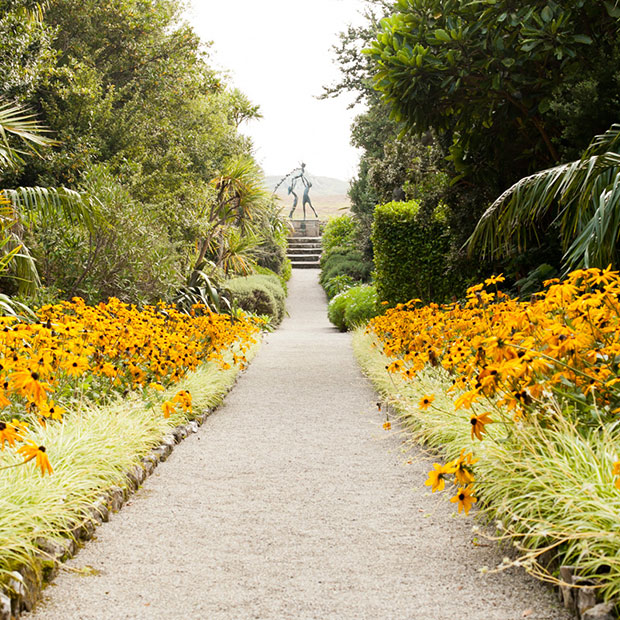
A sunlit path winds through vibrant orange flowers and lush greenery toward a distant statue at Tresco Abbey Garden.
The Italian Awakening: History at Ninfa
More than a thousand miles away, spring arrives at Giardino di Ninfa in a landscape shaped as much by history as by horticulture. Located in the Lazio region southeast of Rome, the garden occupies the site of a medieval town that was gradually abandoned between the sixteenth and seventeenth centuries as the surrounding marshes expanded and malaria became increasingly prevalent throughout the region. By the nineteenth century much of Ninfa had fallen into ruin, before members of the Caetani family began transforming the site into a landscape garden during the early decades of the twentieth century, planting around the surviving architecture rather than attempting to erase it.
Today, the garden covers around eight hectares within a wider protected landscape of more than one hundred hectares and contains over a thousand species of plants and trees growing amongst the remains of churches, defensive walls, bridges and towers that once formed a prosperous settlement on the Appian Way.
The River Ninfa and a network of springs and waterways run throughout the site, creating a humid microclimate that allows an unusually diverse range of plants to thrive amongst the stonework and ruins.
“Spring here is a discovery,” says a representative of the garden. “The blossom refreshes the garden, creating intimate moments of colour and scent around every ruin and waterway.”
Where Tresco’s growing season appears almost continuous, with flowering plants present throughout the year and little distinction between winter and spring, the season at Ninfa is defined by succession, with flowering trees, roses and herbaceous planting emerging in sequence across the landscape as temperatures rise and daylight lengthens, gradually altering the character of the garden over the course of several weeks.
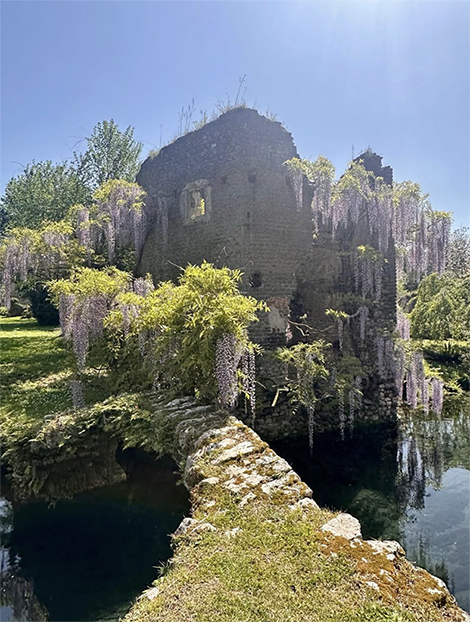
Giardino di Ninfa – a landscape shaped as much by history as by horticulture.
Colour Across the Landscape
At Tresco Abbey Garden, the garden’s terraces create distinct growing conditions, allowing plants from South Africa, Australia, Chile and the Canary Islands to flourish side by side.
Underneath a mixed canopy of evergreen palms and elms, orange aloe flowers, silver foliage and sculptural banksias can be found at ground level.
“On the first of March you can find bluebells all over the garden,” Andrew says. “But mixed in with aloes and aeoniums, which is always a bit of a surprising combination.”
The result is a spring palette unlike almost anywhere else in Britain, shaped as much by geography as by horticultural ambition.
At Ninfa, colour emerges through layers of planting woven amongst the remains of the medieval settlement, where flowering trees, climbing roses and herbaceous perennials occupy spaces that were once streets, courtyards and public buildings.
The garden contains a remarkable collection of plants gathered from around the world, including ornamental cherries, magnolias, cedars, flowering apples, maples and more than a hundred varieties of roses, many of which have been trained across the surviving walls and structures that define the site.
“The shaded groves and water-meadows provide a backdrop,” says the garden’s representative. “While blooms punctuate the landscape with delicate bursts of white, pink and rose.”
The effect is less about large-scale displays and more about the interaction between planting and setting, with flowering branches appearing above ruined walls, climbing roses softening ancient stonework and reflections of blossom moving across the streams and ponds that run throughout the garden.
Water plays an unusually important role in shaping the landscape, with springs emerging from the foothills of the Lepini Mountains feeding the River Ninfa and creating the humid conditions that support much of the planting.
Throughout spring, the colour palette shifts continually as different species come into flower, moving from magnolias and cherries to roses, herbaceous perennials and flowering shrubs, creating constant pockets of subtle interest against a backdrop of cypresses, poplars, meadows and mature trees.
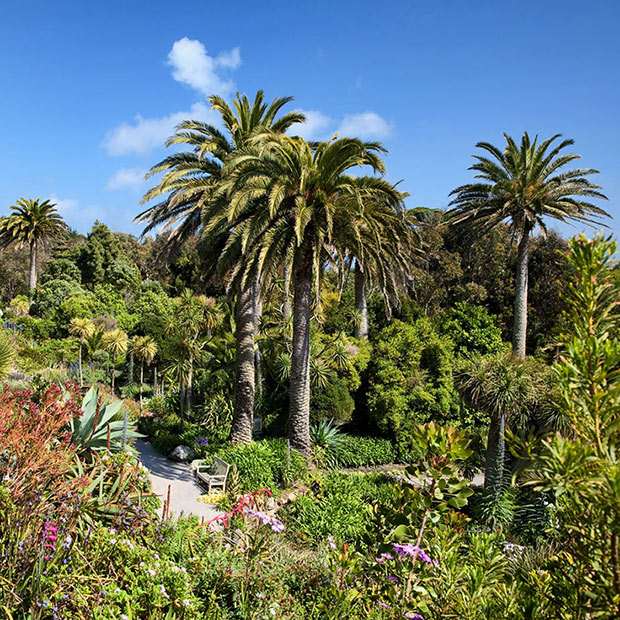
Palms and elms line the pathways
Climate and Planting
Tresco Abbey Garden is shaped by topography and climate. The garden climbs through four south-facing terraces, beginning with damp, sheltered conditions at the base and progressing upwards into increasingly exposed slopes of granite and shallow soil.
The garden itself is arranged across four south-facing terraces, each with its own distinct character. The lowest levels sit in cooler, damper conditions and in close proximity to the lake. Here, moisture-loving plants flourish amongst deep green foliage, tree ferns arch overhead and ground-cover ferns carpet the soil.
“Once you get up onto the next two levels, the middle terrace and the top terrace, you’re on six inches of soil and then base rock granite,” Andrew explains.
The upper terraces are exposed to full sun and Atlantic winds, conditions that would challenge many traditional garden plants but which suit species from some of the world’s most demanding landscapes.
“Those upper levels are full sun, very exposed, and that’s what that plant range likes,” says Andrew. “It’s the Australian, South African, Mexican, Chilean mountain plants and the succulents of the Canary Islands.”
One of the most remarkable aspects of Tresco is that the garden functions almost entirely without irrigation. There are no hidden sprinkler systems keeping exotic plants alive through dry spells. Instead, the planting reflects a philosophy that has become increasingly important as gardens adapt to changing climates.
Andrew says. “It’s very much a right plant, right place sort of scenario.”
Plants are matched to the conditions they evolved in. Moisture-loving Chilean species occupy the lower terraces, while drought-tolerant South African and Australian plants thrive higher up. Rather than grouping collections by country, the garden is organised according to climate and ecology.
People often arrive expecting a botanical arrangement of national collections. What they discover instead is a carefully composed landscape in which plants from different continents coexist because they share similar environmental needs.
“Chile is a good example,” Andrew explains. “Chile is three thousand miles long and has every climate. So you can’t have all of those things in one place. We have Chilean plants at the bottom of the garden that like the wet, and Chilean plants at the top of the garden that like the dry.”
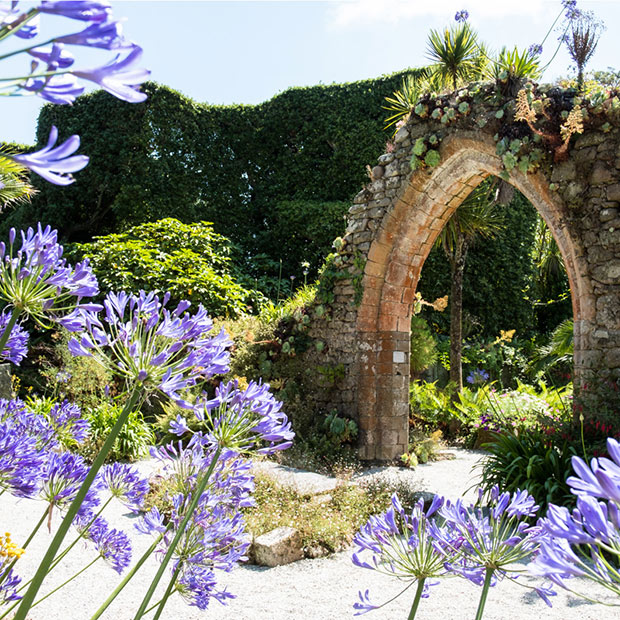
The arch from the wall of the mediaeval monastery at Tresco Abbey Gardens.
Water, Stone, and Mediterranean Microclimates
Ninfa benefits from a distinctive microclimate created by the constant presence of water throughout the site, with springs, streams and the River Ninfa helping to maintain relatively high levels of humidity that support a diverse range of planting.
“Central Italy’s Mediterranean climate shapes the rhythm of spring: mild temperatures and gentle rainfall support layered planting around ruins, waterways, and shaded groves,” says a representative of the garden.
“Microclimates allow both ornamental and historically influenced species to thrive. Bloom follows the contours of the landscape, creating a seasonal experience that is both intimate and immersive.”
The resulting landscape combines native and exotic planting in a manner that feels remarkably natural, with roses, magnolias, flowering cherries, cedars, maples and herbaceous perennials thriving alongside the rivers, meadows and mature trees that have long been part of the site.
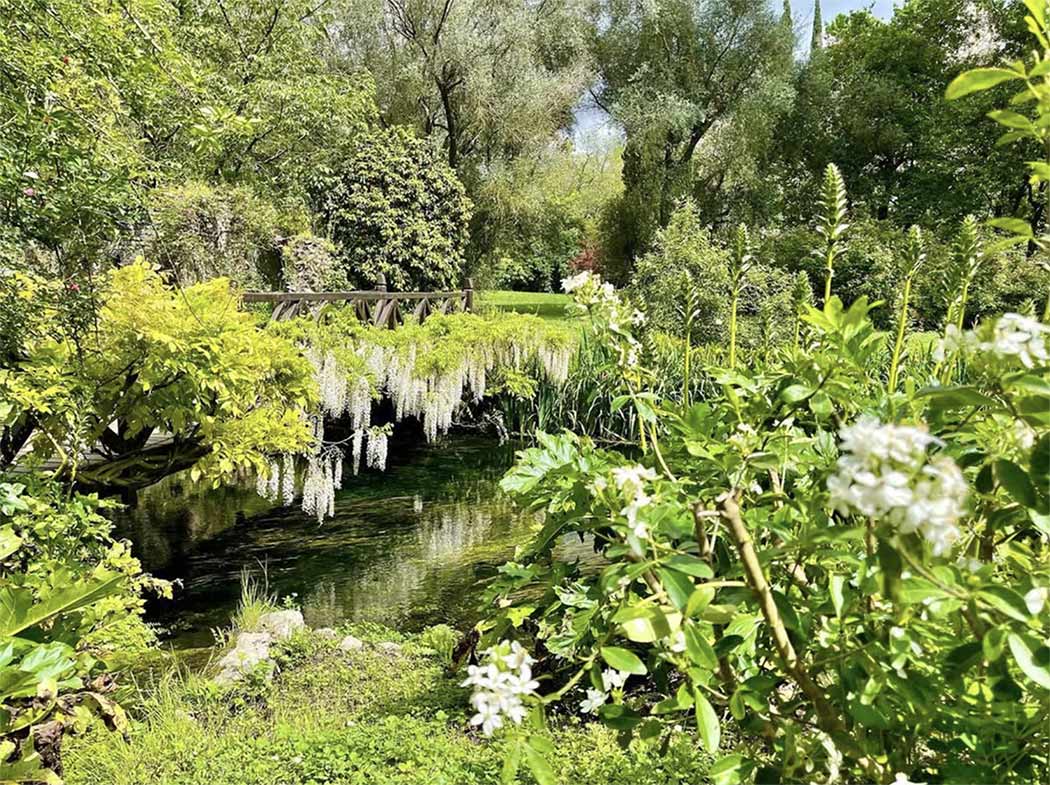
Cascading white wisteria frames a wooden bridge over a tranquil, tree-lined stream in the Garden of Ninfa.
Two Gardens, One Season
What ultimately connects Tresco Abbey Garden and Giardino di Ninfa is not the plants they grow but their distinct sense of place.
At Tresco, the Atlantic Ocean is remarkably important to the garden, moderating temperatures and allowing extraordinary plants from across the world to thrive on a small island thirty miles beyond mainland Britain.
At Ninfa, centuries of history shape every vista, every pathway and every flowering season, creating a garden where nature and architecture have become inseparable.
From the Isles of Scilly to central Italy, spring takes radically different forms. One arrives amongst aloes, proteas and Atlantic winds, shaped by an oceanic climate that allows growth to continue throughout the year. The other unfolds through waterways, flowering trees and the remains of a medieval settlement, where centuries of history remain visible beneath every layer of planting. Both remind us that gardens are ultimately shaped by the landscapes they inhabit, and that spring reveals itself differently wherever climate, geography and human history intersect.