Alex Goodyear has grassy boots. They are thick with Cornish earth and fresh grass clippings, the kind of boots that speak of a morning spent planting rather than behind a desk.
Tremenheere Sculpture Gardens occupies a sheltered fold in the landscape just outside Penzance, where subtropical plants flourish beneath a warm south-facing slope and contemporary artworks emerge unexpectedly between towering foliage. It is a place where sculpture and horticulture exist in conversation rather than competition, each drawing attention to the other, and where Alex, who studied Fine Art before discovering horticulture almost by accident, has found the perfect meeting point between his two passions.
He arrived in gardening through an apprenticeship at a private garden on the Helford after deciding he wanted a vocation that would keep him outdoors and constantly learning, and although he had little formal experience at the time, he quickly became captivated by the endless complexity of plants. More than a decade later, that curiosity still drives everything he does. He talks about plant families, island evolution and ecological relationships with the same enthusiasm other people reserve for favourite novels, and it quickly becomes obvious that for him gardening is less a profession than an ongoing education.
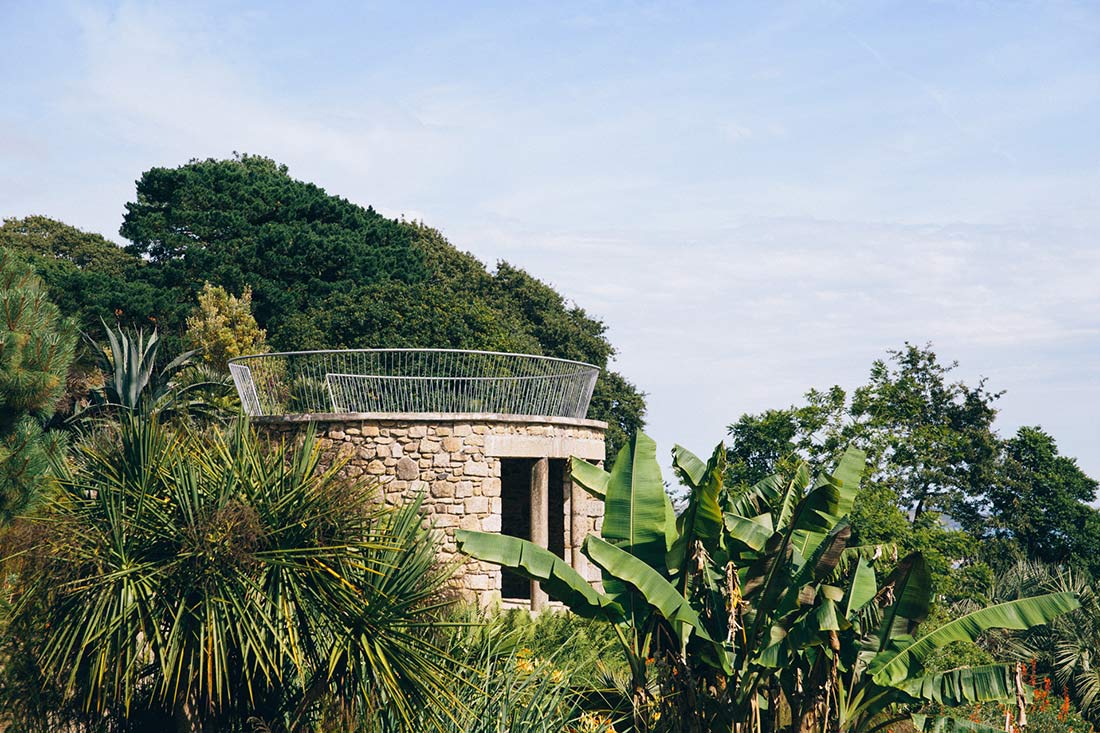
View from the Pagoda. 📸 Karl Davies
A Living Sculpture
Standing beneath towering palms and immense architectural foliage, it becomes easy to understand why Tremenheere suited him so completely. Every turn in the path frames another artwork, yet the plants themselves often feel every bit as sculptural as the bronze, stone or steel they surround.
Alex describes the garden as a living sculpture that changes every day of the year, and his artistic background shapes almost every decision he makes. Pruning is never simply about removing growth. It is about revealing form, creating negative space and controlling how visitors move through the landscape. He speaks enthusiastically about the Japanese concept of ma, where empty space carries as much importance as the objects around it, and explains how carefully removing a branch or opening a small window through dense planting can completely transform the way someone experiences a view.
Those principles extend throughout the garden. Sculptures are given room to breathe rather than crowded together, while planting is chosen to echo their forms rather than overwhelm them. Long, arching leaves mirror sweeping steel curves, elegant grasses soften hard edges, and dramatic foliage creates moments of quiet before the next artwork appears. It is careful choreography, but one that never feels forced.
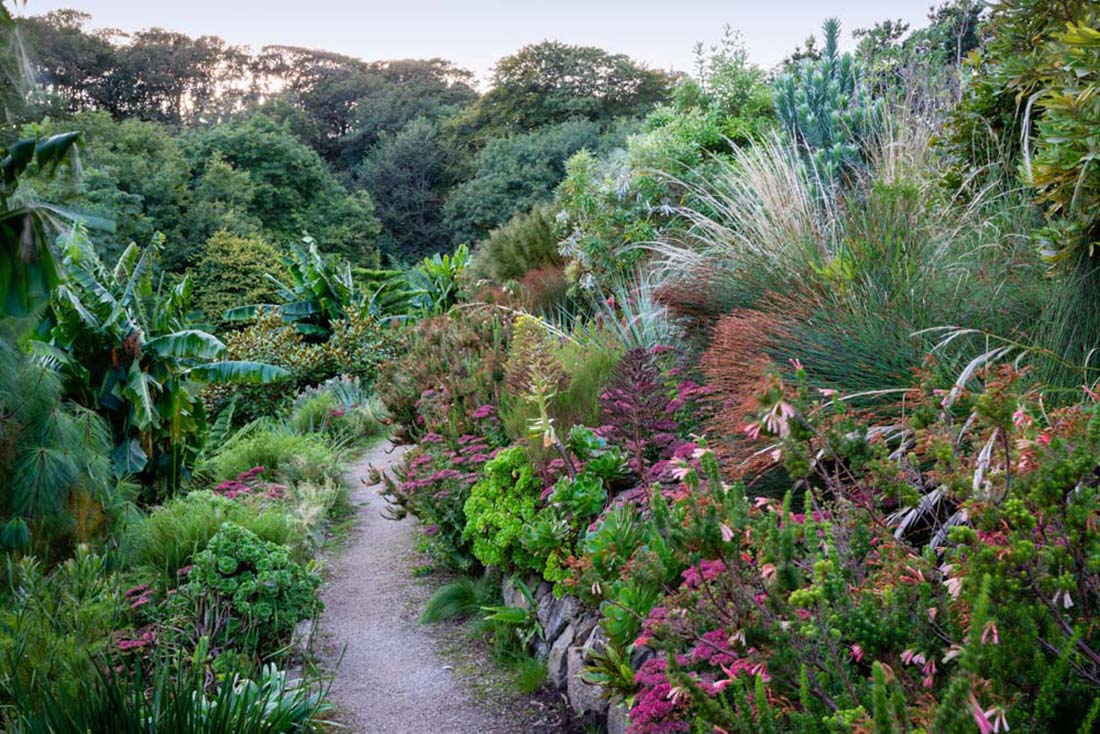
A winding path leads through colourful, richly textured planting at Tremenheere Sculpture Gardens. 📸 Richard Bloom
Gardening for Wildlife as Well as People
Although the planting is undeniably beautiful, aesthetics are only part of the equation. Every decision is also considered through the lens of biodiversity.
Alex’s fascination with insects began long before his interest in plants. Childhood afternoons spent searching for bugs in his grandparents’ garden have grown into a lifelong appreciation of the intricate relationships between plants and wildlife, and he talks about invertebrates with genuine affection. One of his favourite summer sights is watching solitary burrowing wasps carrying vine weevils across the garden, quietly controlling a pest that gardeners usually dread.
That ecological thinking influences the entire planting strategy at Tremenheere. Rather than chasing perfection, Alex is far more interested in creating resilient communities of plants that support equally diverse communities of wildlife. New introductions are chosen not simply because they look spectacular, but because they offer food, shelter or habitat, and because they can thrive with minimal intervention.
The garden itself encourages that philosophy. Without an irrigation system, every plant has to earn its place. Newly planted specimens receive careful attention while they establish, but afterwards they are largely expected to fend for themselves, rewarding thoughtful placement rather than constant maintenance. It is an approach built around observation rather than control, where failure is accepted as part of the learning process and moving plants is simply another stage in discovering where they truly belong.
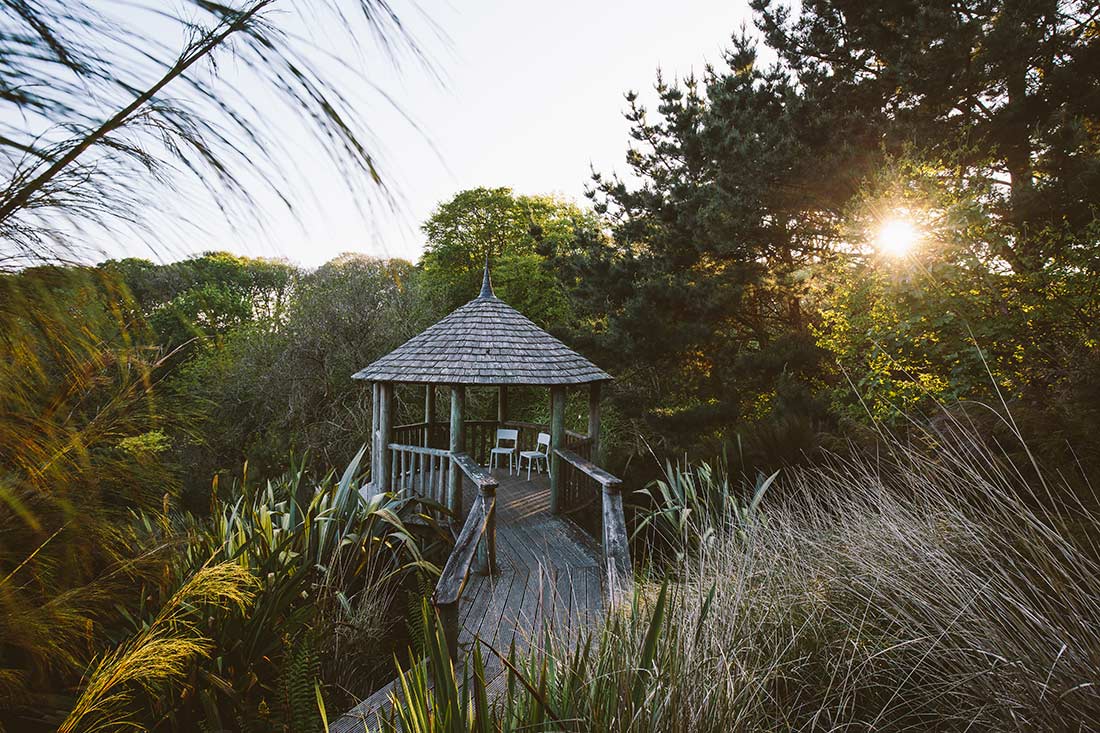
The garden pagoda catches the evening sunlight among grasses and trees. 📸 Karl Davies
Finding Opportunity After the Storm
Like so many Cornish gardens, Tremenheere felt the force of Storm Gorréti.
Rather than simply removing the fallen trees and attempting to erase what had happened, Alex has used their remains as opportunities for creativity. Enormous root balls and exposed root plates have become integral parts of new planting schemes, their sculptural forms now rising from the ground surrounded by carefully chosen drifts of foliage and flowers. Instead of disguising disturbance, the garden celebrates it, allowing visitors to read its recent history while discovering entirely new compositions growing from the damage.
It is a perfect expression of Alex’s philosophy. Conservation is not always about preserving things exactly as they are. Sometimes it means responding creatively, allowing landscapes to evolve while keeping ecological value at the forefront of every decision.
Those new planting areas are as valuable for wildlife as they are visually striking. Dead wood becomes habitat. Open ground allows fresh communities of plants to establish. Fallen trees become the foundations for entirely new ecosystems rather than waste to be tidied away.
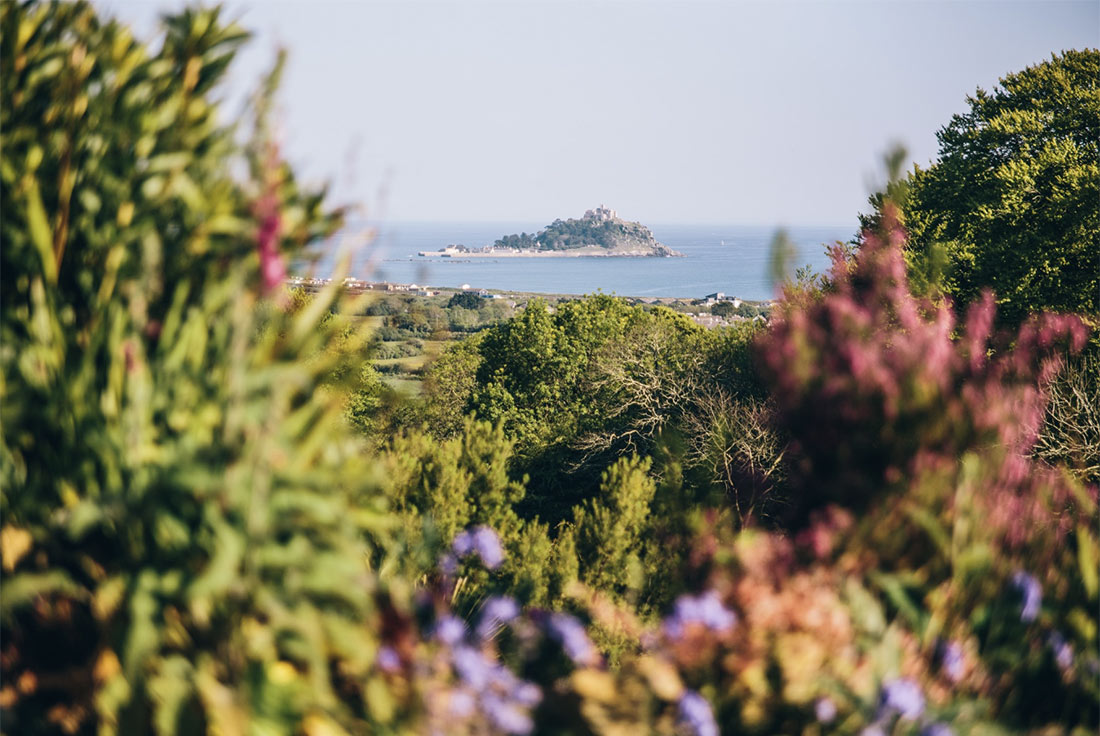
Lush garden planting frames a view of St Michael’s Mount across Mount’s Bay.
Always Learning
Ask Alex what makes a good gardener and he does not mention technical skill first.
Instead, he talks about curiosity.
There is, he says, no point at which you ever finish learning horticulture. One year he might become fascinated by giant tree dandelions from Madeira or the Canary Islands. Another year it could be bark texture, seed propagation or drought-tolerant planting. The more you learn, the more you realise there is still to discover.
That curiosity is something he hopes more young people will embrace. He encourages anyone interested in horticulture to volunteer, to spend time alongside experienced gardeners, and simply to absorb everything they can. Gardening, he believes, remains one of the most generous professions there is, with people eager to share their knowledge rather than guard it.
For younger children, his advice is even simpler. Grow something. Sow a packet of seeds on a windowsill. Root a cutting from a rosemary bush. Watch a tomato plant develop from flower to fruit. The satisfaction of nurturing something alive, however small, is often enough to spark a lifelong fascination.
A Garden That Never Stands Still
Walking through Tremenheere with Alex feels less like touring a finished garden than stepping inside an artist’s studio where the work is permanently in progress. Every path suggests another possibility. Every tree is being quietly edited. Every new planting scheme is part of a much longer conversation between landscape, sculpture and ecology.
By the time we return to the entrance, his boots are even greener than when we started, dusted with fresh cuttings gathered from another morning spent shaping the valley. It seems an appropriate image to leave with, because here, art is not confined to the sculptures standing among the subtropical foliage. It exists equally in every carefully revealed tree trunk, every thoughtfully composed planting scheme, every root plate transformed into a new landscape after the storm, and every human decision that makes the garden richer not only for its visitors but also for the countless birds, insects and other wildlife that now call it home.
In Alex Goodyear’s hands, gardening becomes something far greater than the cultivation of plants. It becomes an act of composition, restoration and quiet optimism, where beauty and biodiversity are never opposing ambitions but two expressions of exactly the same idea.
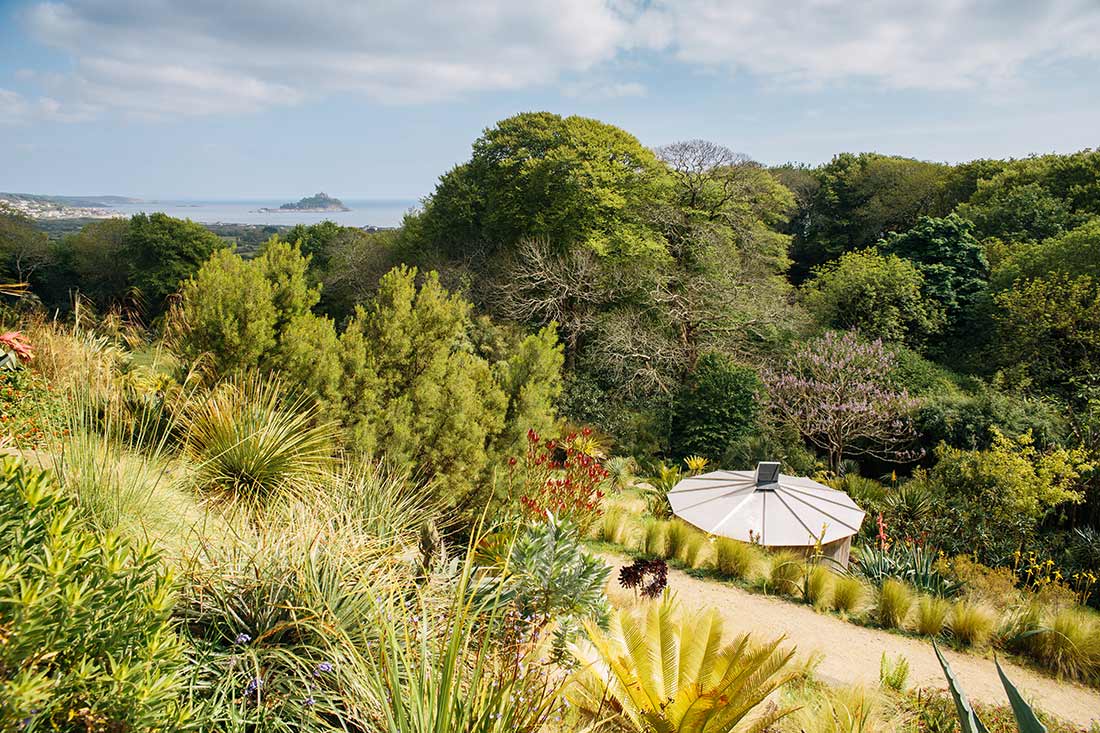
Tremenheere’s hillside gardens overlook the Cornish coast and St Michael’s Mount. 📸 Karl Davies