
Over the lip of the cliff, beyond the grassy auditorium seating and the carved stone stage, the steel grey Atlantic arrives in surges of cerulean and ivory over the granite rocks below.
The air is light and silky with cool moisture from the ocean, and the aeoniums shudder as heavily salted winds hiss and whip up the terraces of the Minack Theatre.
The outlook for the day wasn’t good. The cottony blanket of dark grey cloud high above shifts and flurries in blasts of strong wind. On top of the cliff I wrestle with my car door, regretting not bringing a scarf, but as we pass shivering wax-petalled bromeliads and stoic proteas to drop down into the carved cliff face, the wind suddenly drops to a pleasant breeze. By the time we reach the stage at the bottom of the garden, I’m taking off my coat.
Where Horticulture Meets Shakespeare
The Minack has always felt improbable: a theatre carved into a cliff face hanging off the most South-Western coast of the country, harried by prevailing winds billowing in from the Atlantic.
A garden in these conditions seems like it should be little more than a windswept collection of rocks and hardy grasses. Instead, tucked into the granite terraces, there are giant aeoniums the size of dinner plates, fleshy succulents spilling over stone walls, and proteas standing proud despite the Atlantic weather. Strange and exotic plants that would look at home in the Southern Hemisphere, inexplicably thrive nestled into this craggy stretch of wild Cornish coastline.
“It can be so windy in the car park that you can’t open the door,” says Claire Batten. “And then you get down into the theatre and you’re in shorts.”
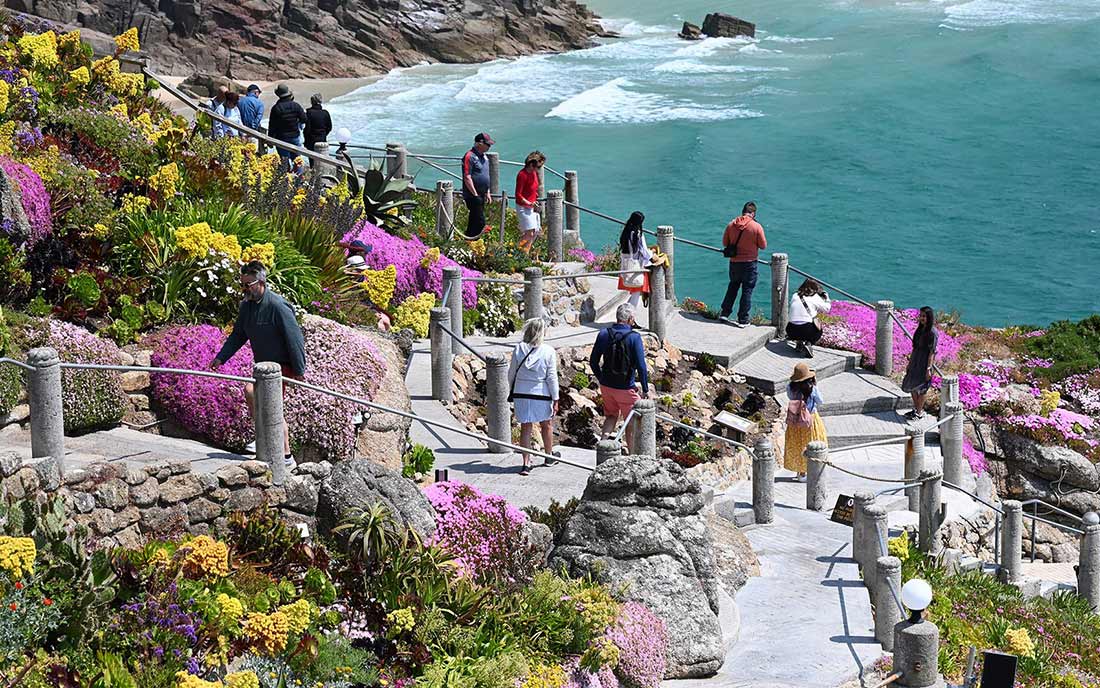
Colourful cliffside planting overlooks the Atlantic sea at the Minack.
Sowing the Seeds Early
Together, Claire Batten and Jeff Rowe manage one of the most unusual gardens in Cornwall. They both arrived at horticulture in the way many gardeners seem to: not through a grand career plan, but because they followed their instincts and couldn’t imagine doing anything else.
“When I was little, I always had a pair of wellies on and was in the garden,” says Claire. “Mum and Dad grew some flowers, and as a child I could often be found in the violet patch.”
Jeff’s childhood sounds much the same: “I used to love sowing seeds in my parent’s greenhouse back when I was seven or eight years old.”
“My dad would just give me loads of vegetable seeds and flower seeds and let me sow them,” he laughs. “…with mixed results.”
Jeff came from a farming family, Claire never wanted an indoor job. Together they built a small nursery business, growing unusual plants in a polytunnel and exhibiting at RHS flower shows around the country.
“We were growing whatever we could propagate,” says Claire.
“But even then what we were growing was different,” Jeff adds. “Things like aeonium, that other gardeners are only just getting into now.”
The Minack Theatre Garden has always occupied an unusual position among Cornwall’s gardens. For the majority of people who arrive here for Shakespeare or the sweeping horizon, the expressive exotic planting comes as an unexpected surprise.
“One of the biggest challenges is working around the theatre,” Claire says. Unlike most gardens, the Minack has actors, stage crews and set designers moving through it for much of the year. Carefully planted areas can suddenly become thoroughfares for scenery. “I had to tell one company last week not to manhandle pieces of scenery over the flower beds,” she says. “Because they don’t see it as a garden.”
The challenge of gardening here begins with the simple fact that almost nobody else sees the place the way the gardeners do. Visitors see a theatre. Actors see a stage. Photographers see the Atlantic.
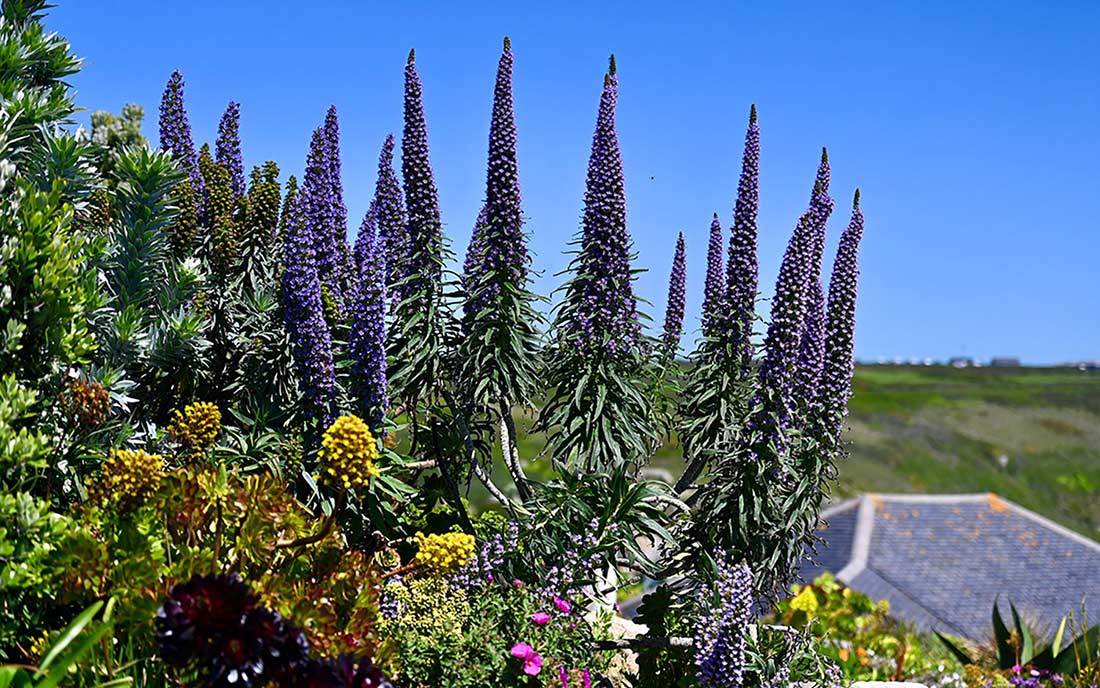
Towering purple echiums in full bloom against a clear blue sky.
Gardening on a Rope
“We are a series of raised beds, not a big twenty-acre garden,” Claire says. “We’re a series of interesting pockets.” Every pocket has to work hard. Unlike a traditional border, which is usually viewed from one direction, almost every planting area at the Minack can be seen from above, below and either side.
“We know what plants we want to put in, we source them, and then you just put the pots straight in the flower bed and walk away,” Claire says. “You’ve got to see it from above, you’ve got to see it from down below. There’s about eight different angles.” Then there is the small matter of gravity.
“We’ve just done our rope course,” she laughs. “Harness, helmet, and you feel a bit of a plonker putting all of that on just to put in half a dozen plants.”
It is one of the few gardening jobs in Britain where abseiling is in the diary somewhere between weeding and deadheading. On calm mornings, Jeff and Claire clip themselves into ropes and edge their way down the cliff face, suspended above the Atlantic while tending to pockets of planting tucked into the granite. The transatlantic breeze whips around them as they hang in mid-air, coaxing a clutch of echeveria into place.
At most gardens, planting involves a trowel and a wheelbarrow, at the Minack it occasionally resembles a military exercise. Everything has to be carried down and back up the many, many carved stone steps – all whilst dodging blissfully unaware visitors . “There’s no quick fix here,” Claire says. “It is back to pure principles and grunt.”
Weathering the Atlantic Elements
And the weather has opinions on all of this.
“We are tremendously exposed,” says Jeff, gesturing out of the windows of the little rehearsal room to the roiling, frothing sea below. “It’s amazing how quick wind changes direction,” he continues. “The general public probably aren’t attuned to it, but when you’re out in it in an exposed position, you can feel it change within five minutes.”
Gardeners, I’ve discovered, talk about weather the way sailors do: with reverence and resigned good-humour.
A shift from south-westerly to westerly might mean very little to most visitors. For Jeff and Claire it can determine whether a day’s work goes ahead at all.
“You can come in expecting to do something,” Jeff says, “and then all of a sudden that’s got to change because it poured with rain overnight and earth washed out of a bed.”
According to Jeff, the unpredictability feels as though it’s become more pronounced in recent years and precipitation seems increasingly difficult to track and to manage, with sudden careless downpours washing away valuable nutrient-rich soil.
“The extreme rainfall, we’ve found challenging at times,” Jeff says. “It seems to have gotten worse.”
Unlike many gardens, the Minack cannot simply plant a shelterbelt and hope for the best. Windbreaks are difficult when you’re gardening on the side of a cliff.
“If it’s straight in the teeth of the easterly wind,” Jeff says, “you’ve just got to live with it.”
The wind and rain may be responsible for the loss of soil and plants from the beds, but they aren’t the only culprit. “We have a little sign saying please take photos, not plants,” says Claire.
The sign exists because visitors have been known to help themselves to the succulents. The sedums, aeoniums, and crassulas, all conveniently handbag-sized and ripe for an illicit one-way voyage out of the gardens – the newly planted and the fresh sprouting alike.
“It’s the way they rummage in an aeonium, and then look at you, and then just take it and walk off,” Claire shakes her head.
“I’m not going to shout at them like a fish wife,” she laughs ruefully. “At that point you just think, do you know what? I’m going to put a spiky one there.”
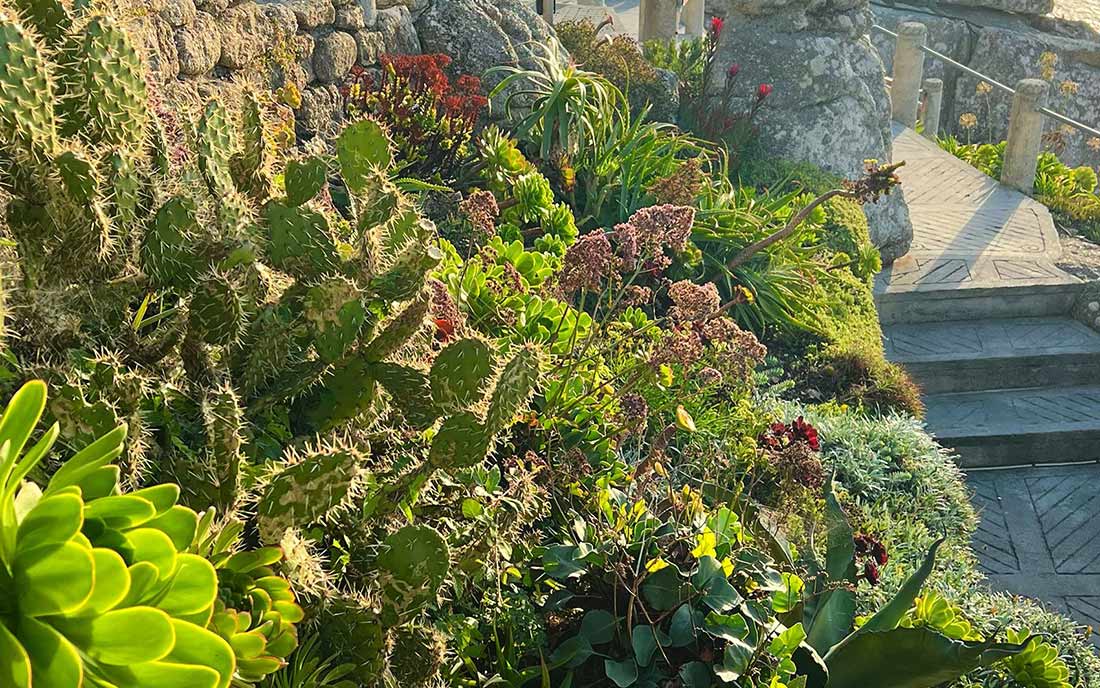
A sunlit bank of succulents.
The Principles of Horticulture
Towards the end of our conversation, I ask what advice they would give to young people considering horticulture, and Claire doesn’t hesitate: “Learn the principles.”
She describes a textbook she studied from at college, a big red tome of a book held in high regard in horticultural circles. An absolute essential for budding gardeners, I’m told, and a book she still occasionally returns to today.
People often underestimate gardening, she says. They see flowers and planting schemes and assume it is decorative and simple. “People think horticulture is a dumb subject, but it’s a science. It’s absolute science.”
Soil, weather, plant physiology, propagation, all of it rests on knowledge accumulated over generations.
According to Jeff, technology can have its small place, particularly weather forecasting – despite regular inaccuracies. And plant identification apps can be a starting point for research and exploration in horticulture, but none of it replaces understanding how things grow.
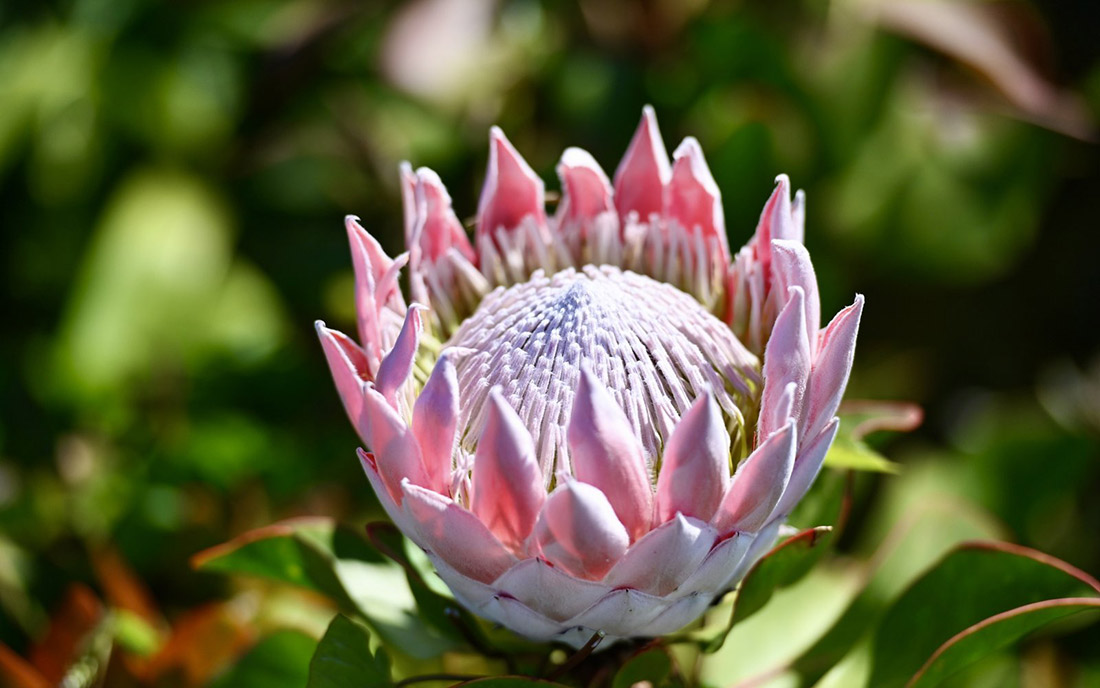
A protea cynaroides at Minack.
A Passport to the World
“Once you really understand the principles, horticulture can take you all over the world. We all talk the same language,” Claire smiles. “The plants are all in Latin, so it doesn’t matter if you’re in Timbuktu or Falmouth.”
Somewhere beyond the stage, waves detonate against the rocks below.
As we finish talking and head back up the carved steps, the weather has changed again. Sunlight rushes through the clouds and catches the silver surface of the sea and the rain-wet granite of the theatre. Somewhere overhead, another gust of Atlantic wind rattles through the sturdy succulents at the top of the garden and flusters a giggling group of tourists as they have their photo taken.
Tomorrow the forecast will probably be different. By lunchtime, it may well have changed again. But for Claire and Jeff, that uncertainty is not a problem to be solved, it is the reality of gardening at the edge of the world.