
The Living Valley
The first thing to reach you at Trebah is the sound.
Before the extraordinary planting announces itself, before the giant leaves, the towering tree ferns or the glimpses of the Helford River far below, there is bright birdsong layered over the constant movement of the garden itself. Wind threads through towering stands of bamboo with a harmonic clatter, rising and falling like distant percussion, while leaves hiss against one another overhead in a language older than the paths beneath them. Somewhere above the valley, a bird of prey catches a funnel of warm, humid air rising from the river and circles almost motionless against the sky.
Trebah has always been a garden that unfolds rather than reveals itself all at once. The steep valley draws you gently towards the water through planting that changes almost imperceptibly with every few metres, while the air itself seems to transform as you descend. Late-flowering rhododendrons release a sweet, heady scent uncannily reminiscent of candied melon before giving way to sharper medicinal notes from eucalyptus and tea trees, and rich woodland loam beneath the canopy. It is a garden experienced as much through sound and scent as through sight, which perhaps explains why generations of gardeners have devoted themselves to constantly refining every corner of it.
Few know those corners better than Darren Dickey.
Head Gardener since 2002, and part of the Trebah team since arriving as a young gardener in the aftermath of the devastating storms of 1990, Darren has spent more than three decades watching the garden mature, recover, adapt and evolve. His knowledge has been built not simply through study but through thousands of mornings spent walking these paths, observing what flourishes, what struggles and how the landscape continually reshapes itself.
“I’ve been very fortunate to be part of that evolution,” he says.
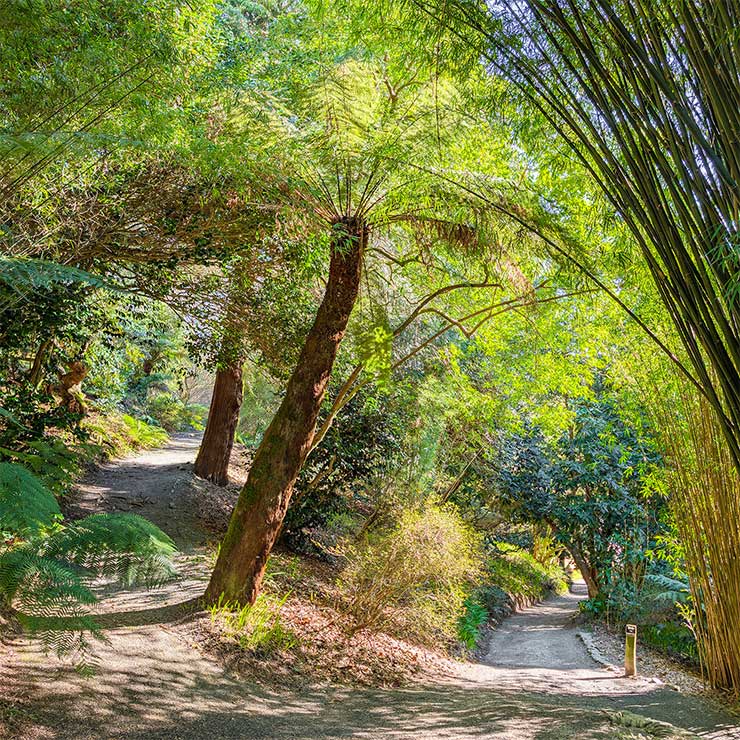
Dicksonia Antarctica Tree Ferns are prolific at Trebah.
A Life Rooted in One Valley
Unlike many gardeners whose careers take them from estate to estate, Darren’s story has remained remarkably local. His family moved from Hampshire to near Mawnan when he was ten years old, settling alongside his grandparents on a nearby farm, and it was there that horticulture quietly became part of everyday life.
His grandfather maintained an enthusiastic mixture of herbaceous borders, shrubs, vegetables and greenhouse crops, while Darren’s parents were equally passionate gardeners, giving him the freedom to dig, sow, explore and inevitably get muddy from an early age. By the time many children are still deciding what they enjoy, Darren already knew exactly where he wanted to spend his future.
“I was very lucky because I knew what I wanted to do from a young age,” he says.
After studying horticulture at Duchy College while completing practical training at nearby Glendurgan, he worked briefly in landscaping before joining Trebah in 1991, where he has remained ever since.
That longevity is increasingly unusual, but it has given him something difficult to acquire any other way: an instinctive understanding of place. Every sheltered corner, every frost pocket, every soil type and every subtle variation in the garden’s microclimate has revealed itself over decades of observation.
“You become very attuned to what you can grow,” he explains. “You learn where plants thrive, where the challenges are, and of course those challenges are changing all the time.”
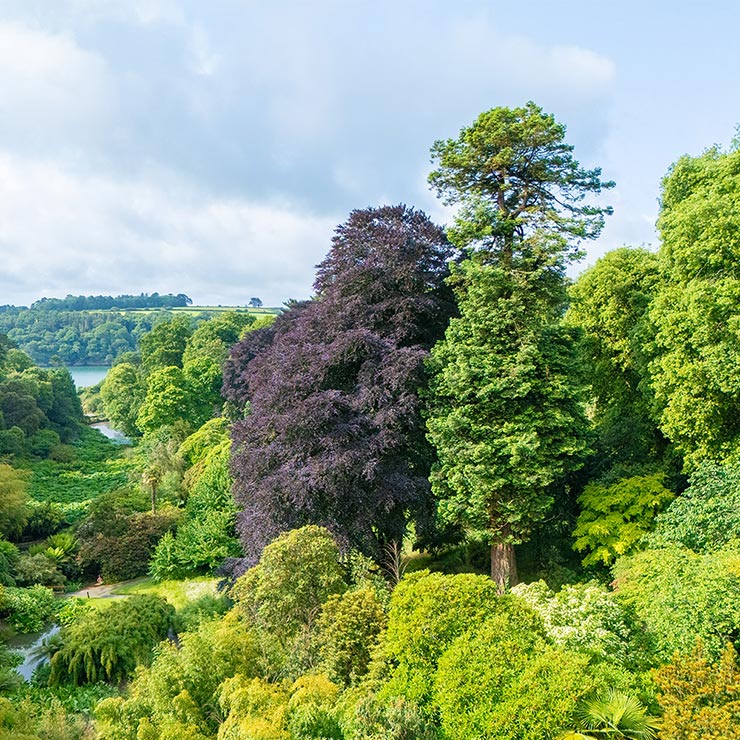
A Coastal Redwood rises high above the exotic canopy and stands next to a Douglas Fir which is thought to be the tallest tree in the garden.
A Garden That Never Stands Still
Although Trebah is often thought of as a historic garden, Darren is quick to point out that its greatest strength lies in continual change.
Each morning begins with the gardening team gathering to decide the day’s priorities before volunteers join them across the valley. Alongside the practical work of planting, pruning and maintaining the collection sits a constant programme of development, from improving visitor access to introducing new planting and refining interpretation.
“The garden should never stand still,” Darren says simply.
That philosophy reaches beyond aesthetics. As a charitable trust, Trebah sees education and inspiration as central to its purpose, encouraging visitors not simply to admire beautiful planting but to understand it, experience it and perhaps feel inspired to create something of their own.
Accessibility has become an important part of that mission. New pathways now allow all-terrain mobility vehicles to reach far more of the garden than before, while improved access to the private beach means visitors who once would have been unable to reach the Helford shoreline can now experience one of Cornwall’s most spectacular views. The recently completed Court Garden offers a level, accessible space quite unlike the dramatic valley beyond, ensuring that more people can enjoy Trebah regardless of mobility.
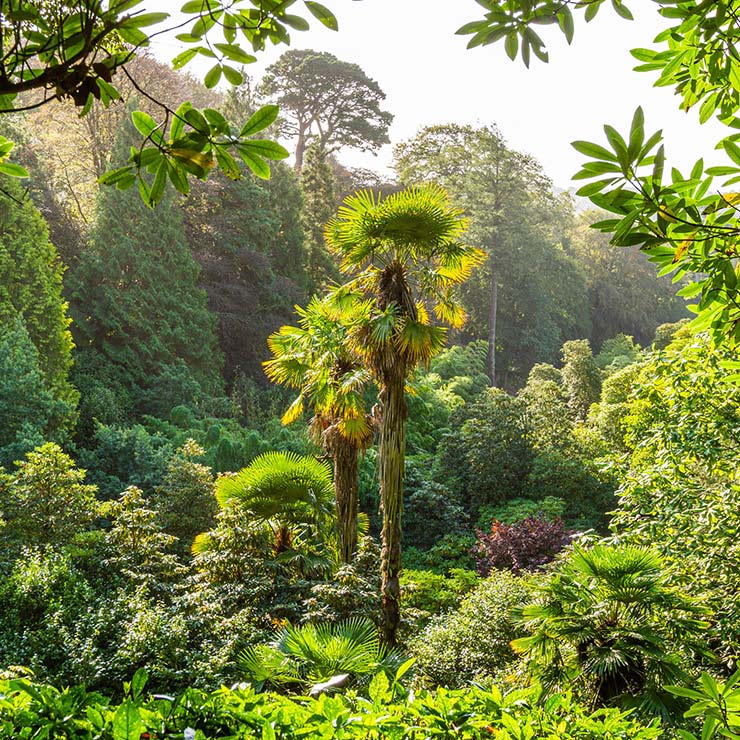
Trebah has many chusan palms throughout the garden, but the tallest stands at around 15m tall.
A Garden for the Senses
Perhaps more than almost any other famous Cornish garden, Trebah understands that beauty is not only visual.
Long before sensory gardening became fashionable, scent was already woven into the garden’s identity, a tradition dating back to Major Hibbert, whose vision helped shape much of modern Trebah. Over the past two decades, Darren and his team have expanded that philosophy, introducing even more fragrant planting to create layers of seasonal experience.
The result is a landscape that changes character not simply with the seasons but from one corner to the next. Visitors move through clouds of perfume carried on warm air, from honeyed rhododendrons to climbing honeysuckle and richly aromatic shrubs whose fragrances drift unnoticed until a breeze releases them.
Those scents are valuable not only for visitors but also for wildlife, attracting pollinators that bring another layer of life into the garden, reinforcing Darren’s belief that every planting decision should serve multiple purposes.
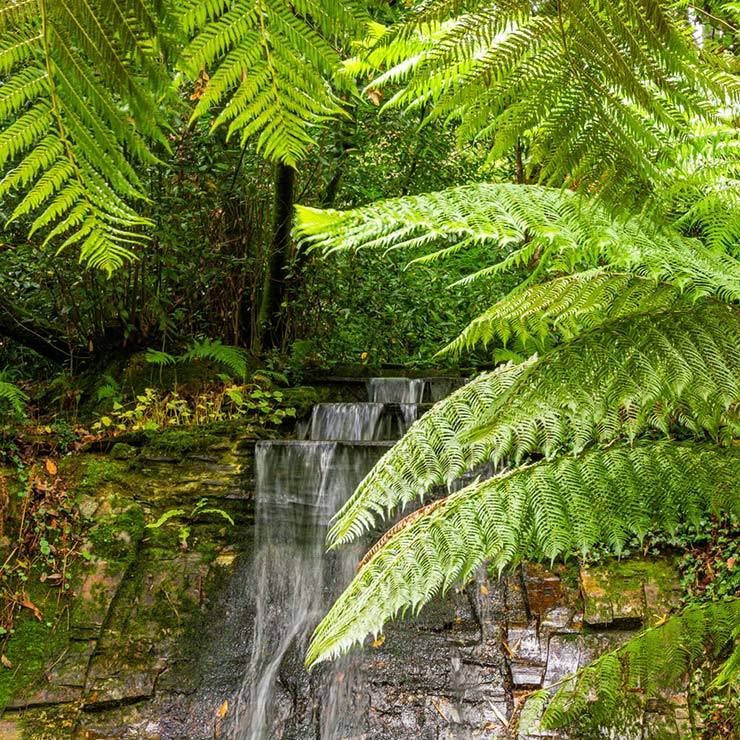
Water cascades over natural rock, framed by lush tree ferns.
Gardening Through the Storms
Like every professional gardener, Darren spends an increasing amount of time thinking not only about today’s conditions but those of decades to come.
Climate change has already altered the conversations taking place within horticulture, and gardens like Trebah are among the first to witness those shifts. Storms have become more violent, weather patterns increasingly unpredictable and traditional assumptions about suitable planting continue to evolve.
The impact of Storm Goretti offered one of the clearest examples. Around twenty-five mature trees were lost across the garden, many forming part of the carefully designed shelter belts that have protected Trebah from Atlantic winds for generations. From the top of the valley, the damage was almost invisible; the fallen trees were hidden within the western shelter belt, which had absorbed the worst of the storm.
“You couldn’t actually see a branch out of place when I came in,” Darren recalls.
Across the Helford, however, a stand of tall, narrow trees had toppled in a chain reaction, one falling into the next like dominoes. Trees grown too closely together, he explains, can become vulnerable when a storm finally breaks through.
Rather than rushing to replant immediately, the team spent months clearing damaged timber before beginning careful discussions about what should replace it. The answers will not come from Trebah alone. Darren regularly meets with neighbouring gardens through the Great Gardens of Cornwall and the Cornwall Professional Gardens Group, where head gardeners compare notes on everything from storm damage to species that have unexpectedly thrived or failed.
“We’ll sit down with Glendurgan next door and have a chat,” he says. “That’s where you bring that collective intellect together.”
It is a quietly reassuring reminder that, despite the prestige attached to many of Britain’s great gardens, horticulture remains an unusually generous profession. Knowledge is shared freely, questions are encouraged and decades of experience pass naturally between gardeners because everyone ultimately faces the same challenges of weather, soil and time.
Possible replacements for the lost trees include magnolias, field maples and other species that have proven more resilient in exposed Cornish conditions. The aim is not simply to recreate what was there before, but to make the garden stronger for the future.
Growing the Next Generation
Darren worries less about whether young people are interested in horticulture than whether they are given enough opportunities to discover it.
Local college courses have become increasingly difficult to sustain, apprenticeships are harder to access than they once were, and many people simply never realise gardening could become a career. Instead, Trebah has focused on internships, volunteering and partnerships with schools, universities and overseas students, believing that practical experience remains the best introduction to the profession.
Interns from mainland Europe regularly join the gardening team, volunteers work alongside experienced horticulturists every day and plans are already underway for new education spaces that will encourage children to explore plants long before they begin thinking about careers.
“It’s about getting people engaged at an early stage,” Darren says.
If an eighteen-year-old asked him how to begin, his advice would be remarkably straightforward. Volunteer. Spend time in gardens. Join community planting projects. Learn from people already doing the work. Above all, spend time outdoors, because no amount of classroom teaching can replace simply living with plants through the seasons.
For Darren, the future of horticulture will be less about controlling nature and more about working alongside it, with fewer chemicals, more biodiversity, greater ecological awareness and stronger links between gardens, communities and schools. Mechanisation will help with some tasks, battery-powered equipment will replace much of the old machinery, but the essence of gardening will remain stubbornly human.
“We’ll always need to climb up a bank and pull some brambles out,” he laughs.
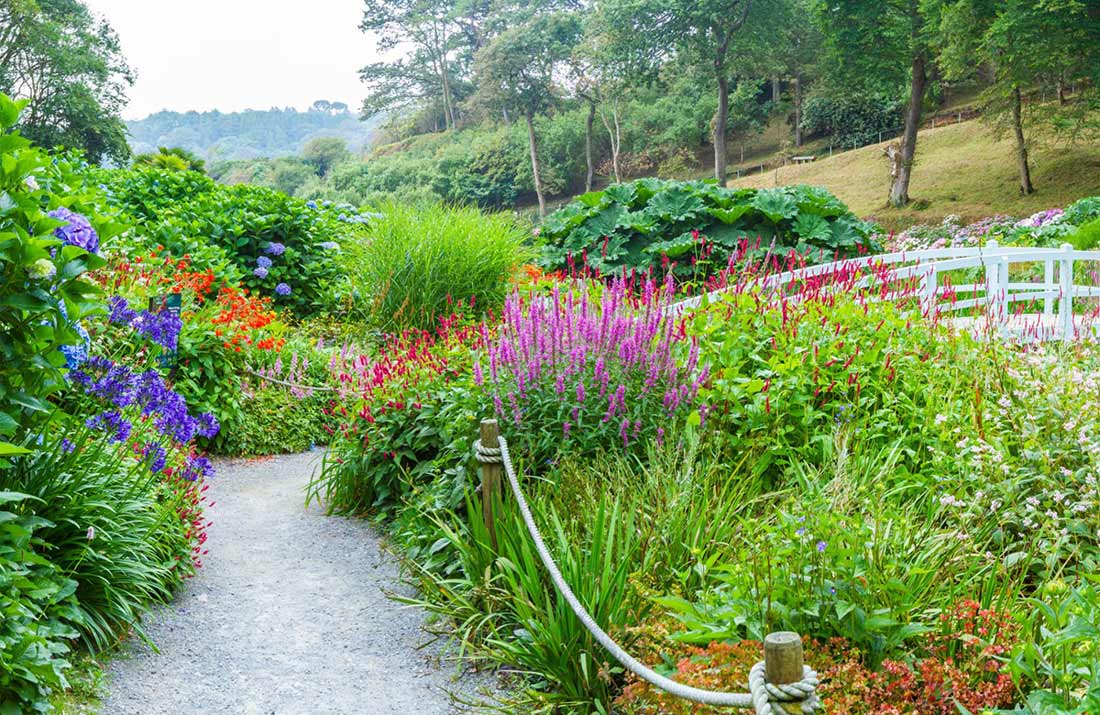
Lush flowers bloom beside the famous Monet-style footbridge spanning Mallard Pond.
A Palette Across the Seasons
What makes Trebah particularly unusual is that the seasons blur into one another rather than arriving in isolated bursts. Late winter and early spring brings enormous pink goblets of Magnolia campbellii opening against otherwise bare branches and flowering camellias, a sea of reds, pinks and whites born from Victorian plant collecting and Cornish conditions. Then come the spectacular displays of rhododendrons, rolling into early summer which brings two and a half acres of blue hydrangeas, their colour intensified by the naturally acidic soil. Autumn arrives in copper beeches, Japanese maples, tulip trees and liquidambars, while winter carries on with scented shrubs, and sweeping valley views.
Woven through every season are the structural plants that never disappear: giant gunnera, tree ferns, palms and bamboo, giving the valley its subtropical backbone even on the greyest day.
It becomes clear, after spending time with Darren, that Trebah has never really been about preserving a perfect moment in time. Every storm opens another chapter. Every season alters the palette. Every generation leaves behind another layer of planting for the next to build upon. The valley is still growing, still adapting and still teaching us what might just be the greatest lesson any garden can offer: that nature is never finished, and neither are the people who choose to spend their lives working alongside it.